
How to Test Your Language Level Online: Best Free & Paid Tools (2025)
Are you actually “fluent,” or are you just “conversational”? It’s a painful moment when you list “Professional Proficiency” on a resume, only to freeze up when a hiring manager switches languages during the interview. I’ve seen it happen more times than I care to count, and it’s rarely because the candidate was lying—they just didn’t know how to accurately measure their skills.
In the digital age, we have access to hundreds of quizzes that promise to tell us our level in five minutes. But here is the hard truth: most of them are vanity metrics designed to sell you a course. They flatter you with a “B2” score when you might barely be scraping a “B1.”
Understanding your true level is critical, not just for your ego, but for the global economy. According to the EF English Proficiency Index (EF EPI) 2024 edition, the worldwide level of English proficiency has declined for the fourth year in a row, with 60% of countries scoring lower in 2024 than in 2023. This creates a massive opportunity for those who can prove their skills.
This guide isn’t just a list of links. It is a roadmap to distinguishing between “app fluency” and “job-ready fluency,” covering the best tools, the science of testing, and how to audit your own skills.
Understanding Language Standards: CEFR vs. ACTFL
Before you click “Start Test” anywhere, you need to understand the ruler you are being measured against. If you don’t know the difference between “Intermediate High” and “B2,” your test results are meaningless numbers.
What is the CEFR? (The Global Ladder)
The Common European Framework of Reference for Languages (CEFR) is the gold standard used by employers globally, from Google to the United Nations. It breaks language ability into six rungs:
- A1/A2 (Basic User): You can survive as a tourist.
- B1/B2 (Independent User): You can work in an office, though you might struggle with nuance. B2 is generally the minimum requirement for professional employment.
- C1/C2 (Proficient User): You can understand implicit meaning, humor, and complex academic texts.
ACTFL Guidelines (The American Standard)
If you are applying for jobs in the United States, you might encounter the ACTFL scale (American Council on the Teaching of Foreign Languages). This scale ranges from Novice to Distinguished. Roughly speaking, an ACTFL “Advanced Mid” correlates to a CEFR “B2.”
According to ACTFL guidelines, the major difference is that ACTFL focuses heavily on functional ability—what you can actually do in real life—whereas CEFR often leans slightly more toward academic structure in its testing methods.
Top Free Online Language Tests (Ranked by Accuracy)
Not all free tests are created equal. In my experience testing dozens of platforms, these are the few that offer data you can actually trust.
1. EF SET (Standard English Test) – The Gold Standard
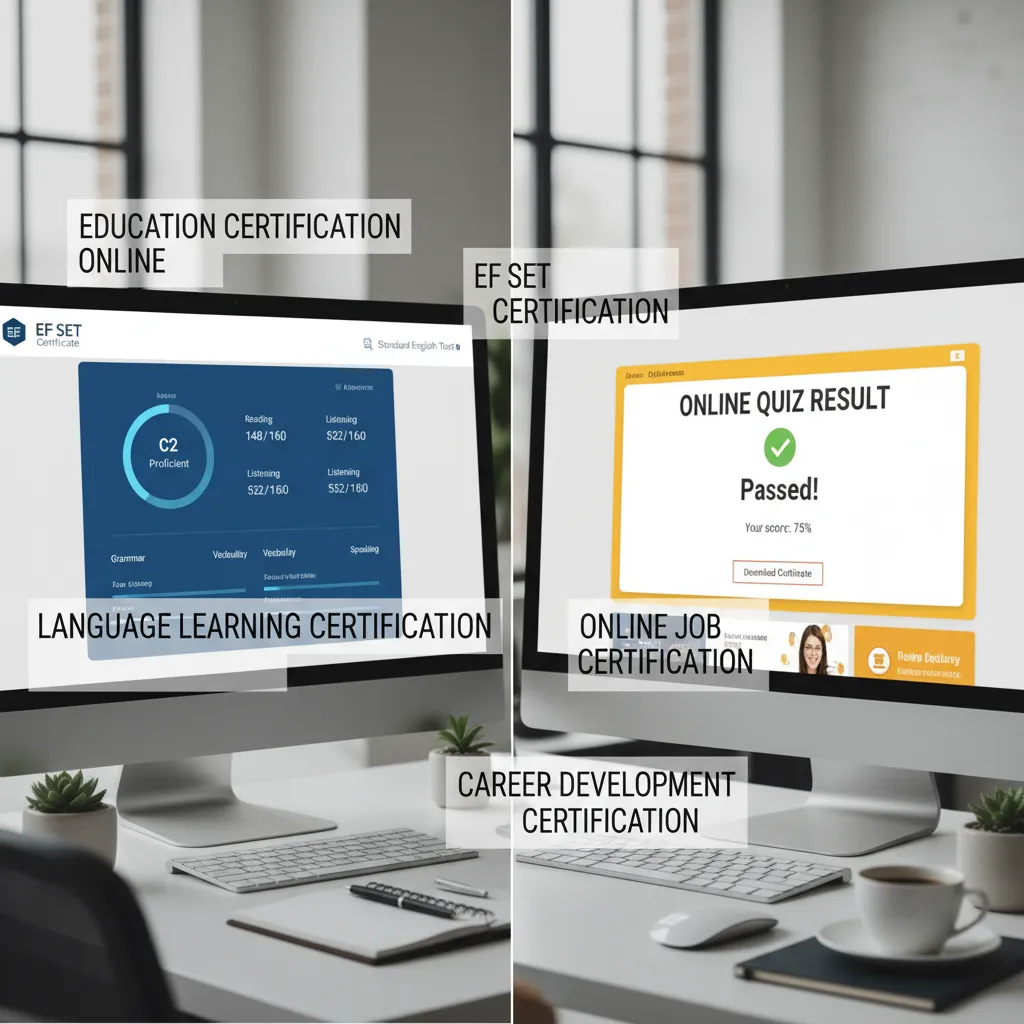
If you only take one test, make it this one. The EF SET is widely regarded as the most accurate free English test available. Why? Because it uses Computer Adaptive Testing (CAT).
Unlike a static PDF quiz, the EF SET adapts in real-time. If you answer a question correctly, the next one gets harder. If you fail, it gets easier. This allows the test to pinpoint your exact level with surprising precision. According to a 2023 study available on ResearchGate, online placement tests like this show a correlation of 0.60 to 0.70 with standardized proctored exams like TOEFL iBT, making them highly valid for initial placement.
Pro Tip: Take the 50-minute version, not the 15-minute quiz. The longer version provides a certificate you can link to LinkedIn.
2. Cambridge English “Test Your English”
For a quick “temperature check,” Cambridge Assessment English offers excellent shorter tests. These are not adaptive in the same deep way EF SET is, but they are built on the same psychometric data used for the official Cambridge exams (FCE, CAE). They are fantastic for deciding which official exam you should book.
3. Dialang – The Academic Diagnostic
This is a hidden gem often overlooked by casual learners. Developed by many European universities, Dialang doesn’t just give you a score; it provides a diagnostic report on why you made mistakes. It separates skills (Reading, Writing, Listening, Vocabulary, Structures) rather than lumping them together.
Professional & Paid Certification Options
Free tests are great for personal knowledge, but for immigration or university admission, you need proctored validation. The market here is shifting rapidly.
The Rise of the Duolingo English Test (DET)
The days of traveling to a physical center to take the TOEFL are fading. According to Pearson‘s 2024 Global English Proficiency Report, testing volumes have shifted significantly toward digital platforms. The Duolingo English Test has become a major player, accepted by over 5,000 universities.
The DET uses AI to grade your writing and speaking, which is efficient but controversial. However, for $59 (compared to $200+ for IELTS), it is the most accessible “official” certificate currently available.
Human-Graded Assessments: iTalki & Preply
If you need to know if you can actually hold a conversation, avoid multiple-choice tests. Platforms like iTalki and Preply offer speaking assessments conducted by real teachers. These aren’t usually recognized for visas, but they are the most honest reflection of your ability to function in a workplace.
The projected size of the digital language learning market by 2025, driven by the demand for verified online credentials. (Source: HolonIQ)
The “Online Inflation” Problem: Why Your Score Might Be Wrong
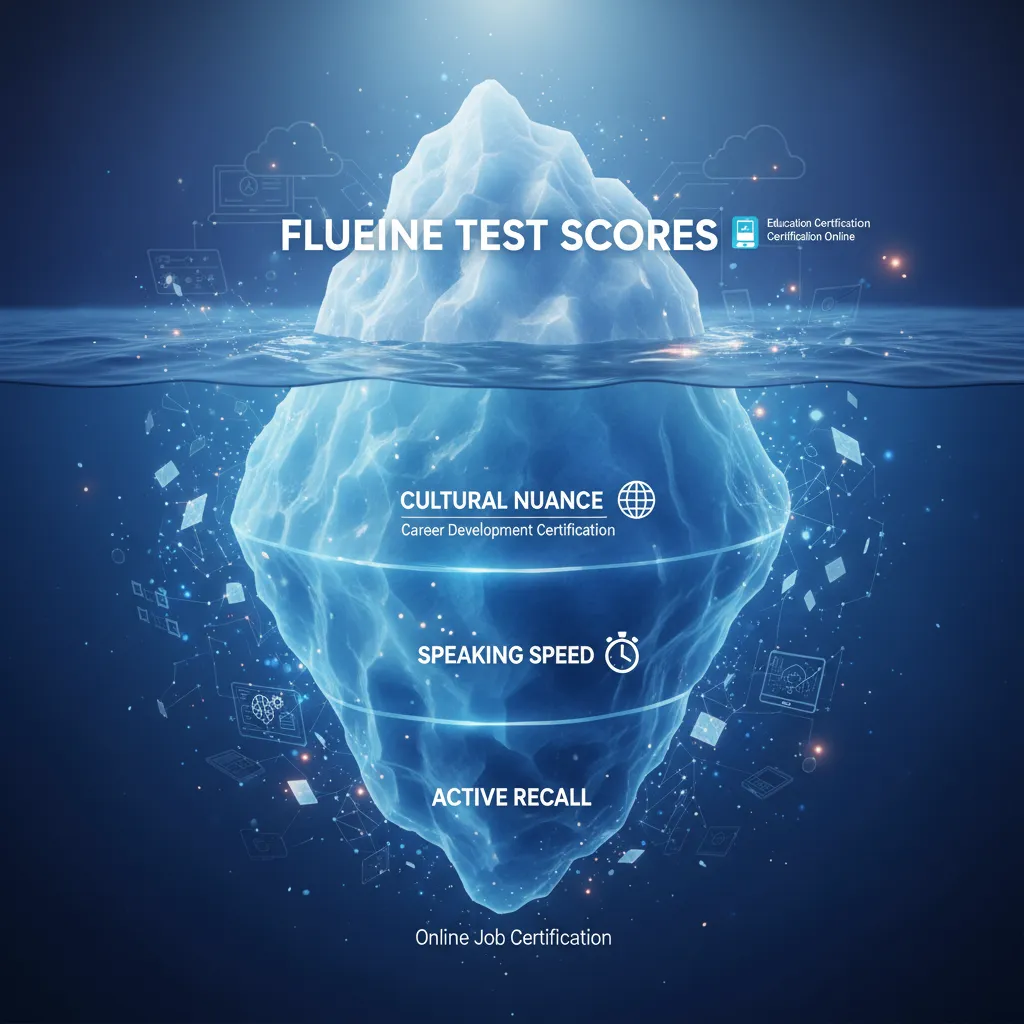
Here is the secret that language apps don’t want to tell you: Recognition is not Recall.
Most online tests rely on multiple-choice questions. This tests your passive knowledge (recognition). You might recognize the correct conjugation of a French verb when you see it on a screen, but that doesn’t mean you can conjure it up during a high-pressure phone call (active recall).
This leads to “Level Inflation.” You might test as a B2 on a reading quiz, but in reality, your speaking skills are stuck at A2. As noted by Dr. Stephen Krashen, a renowned linguist from the University of Southern California, “An online quiz can measure your receptive vocabulary, but it cannot measure your sociolinguistic competence—your ability to read a room and respond culturally appropriately.”
How to Self-Assess Without a Test (The DIY Grid)
Sometimes, honest self-reflection is more accurate than an algorithm. I recommend using the official “Can-Do” statements provided by the Council of Europe.
Interactive Proficiency Estimator
Use this simple tool to estimate where you might land based on your actual daily capabilities.
Simple Fluency Estimator
1. Can you understand the main points of clear standard input on familiar matters (work, school)?
Yes, easily.
No, I struggle.
2. Can you produce simple connected text on topics which are familiar or of personal interest?
Yes.
No.
3. Can you interact with a degree of fluency and spontaneity that makes regular interaction with native speakers quite possible?
Yes.
No.
4. Can you understand a wide range of demanding, longer texts, and recognize implicit meaning (humor, sarcasm)?
Yes.
No.
Additionally, consider your Lexical Coverage. To understand 95% of a spoken conversation, you generally need a vocabulary of about 3,000 words. To understand 95% of a novel, you need closer to 8,000 to 9,000 words. Online vocabulary size tests can help validate this specific metric.
Strategic Approach: The “Triangle of Fluency Validation”
Don’t rely on a single data point. When I advise clients on adding languages to their CVs, I suggest the “Triangle Approach” to triangulation:
- Grammar/Structure: Take the EF SET (50 min) for an objective baseline.
- Comprehension: Use a diagnostic tool like Dialang to find your weak spots.
- Speaking: Perform a self-audit using the CEFR grid or pay for one session with a tutor on iTalki just for assessment.
Average these three findings. If EF SET says C1, but your tutor says B2, list B2 on your resume. It is always better to under-promise and over-deliver.
FAQ: Common Questions About Online Testing
A: Yes, for general employment, listing an EF SET score is acceptable, especially if you include the URL to your certificate on LinkedIn. However, for government jobs, visa applications, or university entry, you will almost certainly need a proctored exam like IELTS, TOEFL, or DELF.
A: This is the most common confusion. C1 represents “Effective Operational Proficiency”—you can work, study, and argue in the language. C2 is “Mastery.” The difference isn’t grammar; it’s cultural immersion. According to Cambridge Assessment English, many native speakers would actually struggle to pass a formal C2 exam because it tests academic rigor, not just fluency.
A: The EF SET is English-only. For German, stick to the Goethe-Institut online placement test. For Spanish, the Instituto Cervantes offers the AVE Global test. Using a generic “multi-language” quiz site often results in poor accuracy for languages with complex grammar like German or Russian.
Conclusion
Testing your language level online is a powerful tool, but it is a compass, not a destination. The scores you get from EF SET or Duolingo are data points that help you identify the gap between where you are and where you want to be.
Remember the economic reality: Gitnux Market Data reported in their 2024 “Bilingualism in the Workplace Report” that bilingual employees earn a 5% to 20% salary premium. That premium is only available to those who can prove their skills—and back them up when the pressure is on.
Use the free tools to track progress, use the paid tools for certification, and use the self-assessments to stay humble. Now, go find your gap and build your bridge.