
How to Move Into Management with Online Certs: The 2025 Career Pivot Guide
Stuck in the “individual contributor” trap? You know the feeling. You’re the go-to person for solving technical problems, but when promotion time rolls around, you’re overlooked for leadership roles because you lack “management experience.” It’s the classic chicken-and-egg scenario: you can’t get the job without the experience, but you can’t get the experience without the job.
Here’s the thing: In 2025, you don’t need a $50,000 MBA or two years off work to break that cycle. The landscape has shifted dramatically.
According to the Coursera Learner Outcomes Report 2023/2024, 77% of learners report career benefits, such as a new job or promotion, after completing online courses.
In my years coaching professionals through career transitions, I’ve seen the “micro-credential” become the most potent tool for signaling ambition. But simply clicking “enroll” isn’t enough. You need a strategy to translate a digital certificate into a physical promotion.
This guide isn’t just a list of courses. It is a data-backed, 5-step roadmap to choosing, earning, and leveraging the right certification to force a pivot from “doer” to “leader.”

Why 2025 is the Year of the “Micro-Credential” Manager
We are witnessing a fundamental shift in how companies hire. The old guard relied heavily on pedigree—where you went to school and who you knew. Today, we are in a skills-based economy. Employers are desperate for people who can actually do the job of managing, not just talk about it.
According to LinkedIn’s Workplace Learning Report 2024, internal mobility is a top priority, with “helping employees develop their careers” jumping to the #4 focus area for L&D professionals globally. Companies want to promote from within, but they need proof of competence.
This creates a massive opportunity for you. By securing an online management certification, you bridge the trust gap. You show your employer that you possess the theoretical framework to lead, even if you haven’t held the title yet.
Jeff Maggioncalda, CEO of Coursera, put it best in his 2024 keynote on the Skills-Based Economy: “In a world of accelerating change, it is not just about what you know, but how fast you can learn. Online certifications are becoming the new currency for career mobility.”
And let’s talk about the money. It’s not just about the title; it’s about the paycheck.
The Salary Premium
According to the Project Management Institute (PMI) Salary Survey 13th Edition (2024 Data), PMP certification holders earn a median salary 33% higher than those without it ($120,000 vs. $93,000).
Top 3 “Tier-One” Management Certifications (Ranked by ROI)
Not all certificates are created equal. If you put a generic $15 Udemy course on your resume, it might show interest, but it won’t command respect. To move into management, you need “Tier-One” certifications that are recognized globally. Here are the top three for 2025.

1. The Gold Standard: Project Management Professional (PMP)
If you have some experience leading projects (even informally), this is the heavyweight champion. It is rigorous, requires an exam, and is universally respected.
- Best For: Professionals with 3+ years of work experience looking for significant salary bumps (upskilling for management positions).
- The ROI: As mentioned, the PMI data confirms a massive 33% salary premium.
- Why it works: It proves you understand the “science” of management: risk, budget, scope, and stakeholders.
2. The Ivy League Hack: Harvard/Wharton Online Certificates
You want the Harvard brand on your LinkedIn profile without the Harvard tuition? HBS Online offering courses like “Management Essentials” is the strategic play. It signals high ambition and intellectual rigor.
- Best For: Resume prestige and signaling to executives that you speak their language.
- The Impact: According to the HBS Online Learner Survey, 90% of certificate earners feel more prepared for their next career step.
- Why it works: It changes the perception of you from “technical expert” to “business strategist.”
3. The Tech Fast-Track: Google Project Management Professional Certificate
If you are starting from zero—meaning no project experience and a tight budget—this is your entry point. Hosted on Coursera, it’s practical, affordable, and recognized by top tech employers.
- Best For: Complete beginners and career pivoters.
- The Value: It focuses on Agile and Scrum—methodologies used by modern software teams.
- Real-World Stat: According to Coursera, 75% of Google Career Certificate graduates in the U.S. report an improvement in their career trajectory within six months of completion.
Step-by-Step: How to Pivot from “Doer” to “Leader”
Buying the course is the easy part. The hard part is changing how people see you. You need to operationalize your learning. Here is the strategy I recommend to clients.
Step 1: The “Gap Analysis”
Before you enroll, look at the job description of the manager role you want. Identify the specific skills you lack. Is it budgeting? Is it conflict resolution? Is it “Agile methodology”?
According to the ManpowerGroup / Coursera Job Skills Report 2024, 4 in 5 employers report difficulty finding skilled talent. If you can identify exactly which skill your team is missing and get certified in that, you become the solution to their problem.
Step 2: Pitching the Investment to Your Boss
Don’t just pay for it yourself. Ask your employer to sponsor you. This does two things: it saves you money, and more importantly, it alerts them that you are ready for growth.
Here is a template you can copy/paste right now. It uses the “benefit to the company” angle.
Subject: Proposal for Professional Development / Team ROI
Hi [Boss’s Name],
I’ve been analyzing our team’s upcoming goals for Q3, specifically regarding [Project Name or Team Goal]. To help us hit those targets more efficiently, I’ve identified a skill gap in [Specific Skill, e.g., Agile Project Management] that I believe would streamline our workflow.
I’d like to enroll in the [Name of Certification]. It costs [Price] and takes about [Time] to complete outside of work hours.
The return on investment for the team would be immediate: I could apply the [Specific Methodology] modules to our current project to reduce [Specific Pain Point, e.g., meeting times or budget overruns].
Would you be open to the company sponsoring this training?
Best,
[Your Name]
Step 3: The “Shadow Management” Phase
Once you are enrolled, don’t wait to finish to start leading. Linda Hill, a Professor at Harvard Business School, famously noted in her research that “Leadership is about using yourself as an instrument to get things done.”
Start applying the concepts immediately. If you learn about “Stakeholder Analysis” in week 2, create a stakeholder map for your current project and share it with your boss. This is what I call “Shadow Management”—doing the job before you have the title.

Resume Surgery: How to List Certifications for Maximum Impact
Most people make a critical mistake: they bury their certifications at the bottom of their resume under “Education.” If you are pivoting, your certification is more relevant than your degree from 10 years ago.
The Strategy: create a section near the top titled “Certifications & Core Competencies.”
Don’t just list the name. List the skills. For example:
- Instead of: Google Project Management Certificate
- Write: Google Project Management Professional Certificate (2025) — Competencies: Strategic Planning, Agile/Scrum Leadership, Risk Management, Asana/Jira Administration.
This triggers the Applicant Tracking Systems (ATS) looking for keywords like “Strategic Planning” and “Leadership” that are usually absent from an individual contributor’s resume.
Real-World Success Stories
I find that examples often clarify the path better than advice. Here are two distinct pivots based on real scenarios.
Case Study: Kate M. (The Career Pivoter)
Background: Classroom teacher for 10+ years looking to leave education.
The Hurdle: Recruiters saw her as “just a teacher.”
The Move: She took the Google Project Management Certificate. She realized that “lesson planning” is actually “resource allocation” and “parent conferences” are “stakeholder management.”
The Result: She landed a Content Manager role at an EdTech firm with a $20k salary increase. The certification gave her the vocabulary to translate her teaching skills into business speak.
Case Study: Michael Davis (The Internal Climber)
Background: IT Specialist, great at coding but stuck closing tickets.
The Hurdle: Too valuable as a coder to promote.
The Move: He earned the PMP Certification. He started using PMP templates to organize the IT team’s backlog.
The Result: Promoted to IT Project Manager within 6 months. As noted in the PMI data, this move aligned him with the higher earning bracket of certified managers.
FAQ: Moving into Management
Does a certificate really replace a degree?
It depends on the company, but the trend is undeniably shifting. Top firms like Google, IBM, and Tesla have removed degree requirements for many roles. A certificate shows current relevance, whereas a degree earned 15 years ago might not. While it doesn’t “replace” a degree in academic terms, it often replaces the requirement for one in the hiring process.
Which is better: MBA or PMP?
An MBA is a long-term strategic play for executive leadership (C-Suite). A PMP is a tactical play for operational management. If you want to manage projects and teams now, the PMP is faster, cheaper, and has a more immediate ROI for new managers.
Can I become a manager without a degree if I have a certificate?
Absolutely. The “Paper Ceiling” is crumbling. If you have a portfolio of successful projects (Shadow Management) combined with a recognized certification (PMP or Google), you demonstrate capability. The key is to highlight your results over your pedigree.
Conclusion: Your Move
Moving into management isn’t about waiting for someone to tap you on the shoulder. It’s about building the toolkit that makes your promotion inevitable. Organizational psychologist Adam Grant noted in a 2024 interview that “The shift from individual contributor to manager requires a fundamental shift in mindset from ‘me’ to ‘we’.”
Online certifications are the bridge to that “We” mindset.
Your Immediate Checklist:
- This Weekend: Conduct your “Gap Analysis.” Browse LinkedIn for your dream manager role and note the missing keywords.
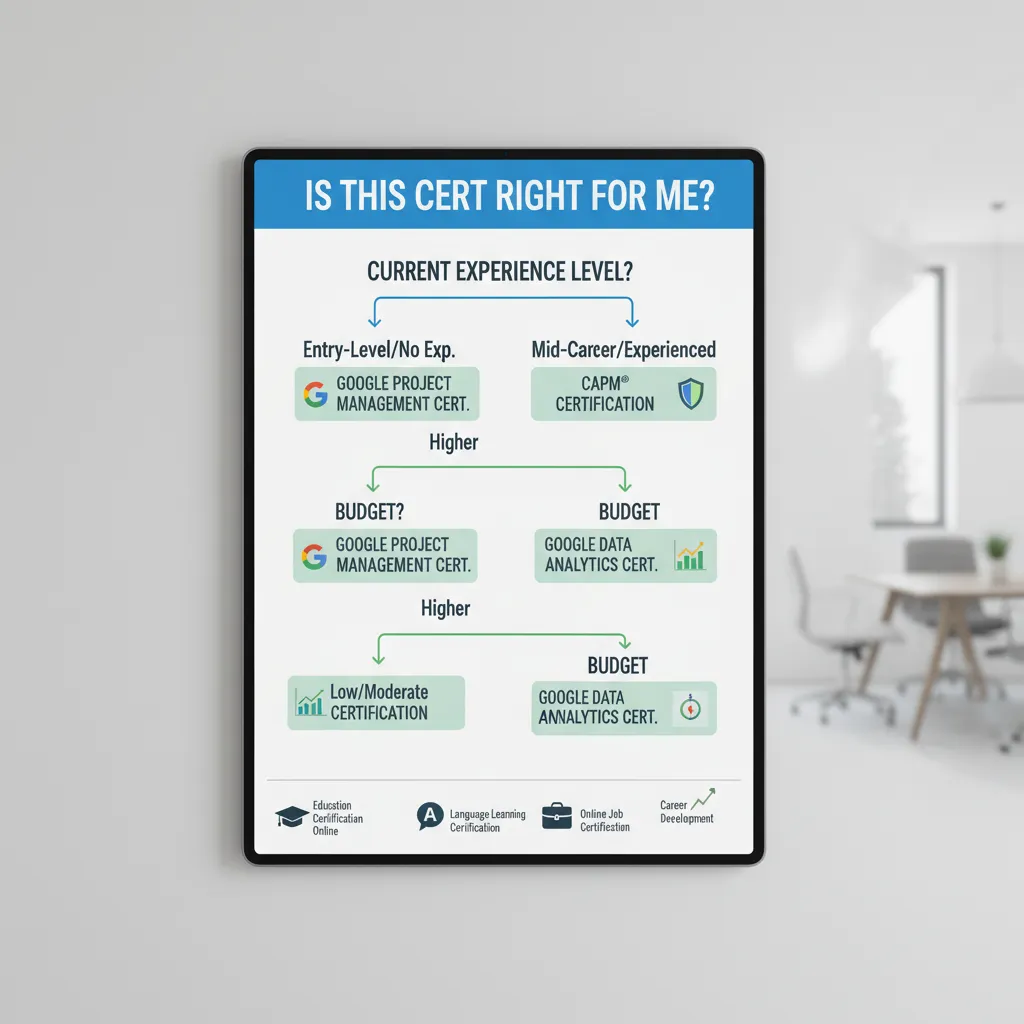
- Monday: Choose your certification (PMP for pros, Google for pivoters, HBS for polish).
- Tuesday: Send the pitch email to your boss.
The ceiling isn’t as solid as it looks. You just need the right ladder.