
How to Get a Management Certificate Online: A Step-by-Step Career Guide (2025)
In 2024, professionals holding a Project Management Professional (PMP) certification earned a median salary 33% higher than their non-certified peers. That isn’t just a slight bump; that’s a lifestyle change. Yet, if you type “management certificate online” into Google, you are bombarded with thousands of options ranging from $50 Udemy courses to $50,000 executive diplomas.
I’ve seen too many brilliant colleagues waste thousands of dollars on certificates that end up being nothing more than digital wall decorations. They choose programs with no accreditation, no networking value, and zero recognition from hiring managers.
If you are looking to pivot into leadership or negotiate a raise in 2025, you need more than just a course list. You need a strategy.
This guide is different. We aren’t just going to look at what to study; we are going to cover the financial logistics of getting your employer to pay for it (using specific IRS tax codes), how to choose a program that offers verifiable ROI, and how to leverage that certificate into a promotion.
Key Takeaways
- Salary Impact: Specialized certs (like PMP) offer measurable salary premiums (up to 33%).
- Funding: IRS Section 127 allows employers to give you $5,250 tax-free for education.
- Market Demand: 1/3 of recruiters plan to hire more management grads in 2025.
- Platform Choice: Distinguish between “Skills Training” (Coursera) and “Executive Ed” (HBS/Wharton).

Step 1: Define Your “Management Track” (The Critical First Step)
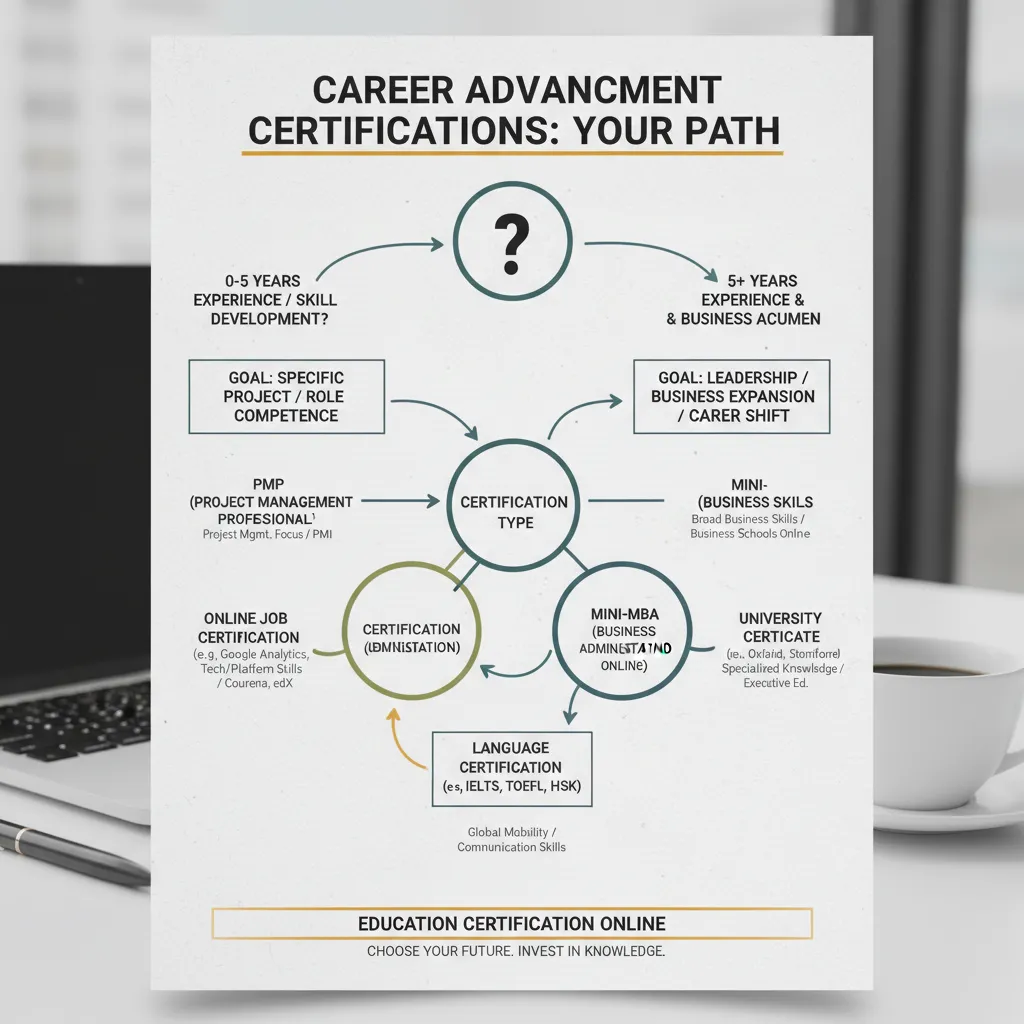
Before you spend a dime, you must diagnose your career stage. A generic “Business Management” certificate is often too broad to be useful in today’s specialized market. In my experience coaching professionals, I see three distinct tracks. Choosing the wrong one is the most common mistake applicants make.
1. The Technical Leader (Project Management Focus)
If you manage timelines, budgets, and cross-functional teams, general leadership theory won’t help you much. You need hard skills. This is where certifications like the PMP or Agile designations shine. According to Project Management Institute (PMI) data from their 13th Edition Salary Survey, PMP holders command a median salary 33% higher than those without it. This is the highest immediate ROI track available.
2. The Career Pivot (The “Mini-MBA” Track)
You are a specialist (engineer, marketer, teacher) wanting to move into general management. You don’t have the time or $100k for a full MBA. Here, you need “business acumen”—accounting, strategy, and operations. Programs like the Harvard Business School Online CORe or similar “Mini-MBA” programs are designed for this. They signal to employers that you understand the language of business.
3. The Executive Polisher (Strategic Leadership)
You are already a manager, but you want to break into the C-suite. You need soft skills: negotiation, organizational change, and emotional intelligence. According to Joy Jones, CEO of GMAC, as AI reshapes the labor market, “employers are putting a premium on strategic thinking, people leadership, and problem-solving.” Certificates in “Organizational Leadership” or “Strategic Management” from top-tier universities fit here.
Step 2: Vetting Programs for Maximum ROI
Once you’ve picked your track, how do you filter the noise? With the global e-learning market projected to reach $1 trillion by 2028 according to a 2024 report by Global Market Insights, diploma mills are everywhere. Use this vetting criteria:
Accreditation vs. Industry Recognition
For university programs, look for AACSB accreditation. It’s the gold standard for business schools. However, for technical tracks, industry recognition trumps academic accreditation. A PMP from PMI or a Google Career Certificate is often more valuable than a generic certificate from a Tier-3 university because it aligns with specific job descriptions.
Synchronous vs. Asynchronous Learning
This is where your lifestyle dictates your choice:
- Asynchronous (Self-Paced): Platforms like Coursera or edX. Great for flexibility, but completion rates are lower because you lack accountability.
- Synchronous (Cohort-Based): Programs like HBS Online or Wharton Executive Education often have start dates and deadlines. Why choose this? Networking. In a recent impact report, HBS Online noted that “74% of learners said HBS Online was better at making learners feel like part of a global network or business community than other providers.” If you need connections, you must choose a cohort-based program.
Step 3: Top Online Management Certificate Programs (2025 Reviews)
Based on current market data and learner outcomes, these are the standout programs for 2025 across the three tracks we defined.
| Program | Best For | Est. Cost | Duration | Key Value Prop |
|---|---|---|---|---|
| Google Project Management (Coursera) | Beginners / Pivoters | ~$39/mo | 3-6 Months | Low risk, high recognition for entry-level. |
| PMI Project Management Professional (PMP) | Experienced Managers | $405-$555 + Exam | Self-Paced | 33% Salary Premium (Highest ROI). |
| HBS Online (CORe or CLIMB) | Aspiring Execs | $1,750 – $2,500+ | 10-17 Weeks | Ivy League brand & Case Study method. |
| Cornell / Wharton Online Certificates | Senior Leadership | $3,600+ | 2-4 Months | Deep specialization (e.g., Change Management). |
The Budget-Friendly Giant: Coursera & Google
Don’t underestimate these “micro-credentials.” According to Coursera’s Learner Outcomes Report 2025, 89% of learners reported a positive career outcome (like a raise or new job) after completing a course. If you are paying out of pocket and need to prove basic competency, start here.
The Executive Choice: Harvard Business School Online
I often recommend HBS Online not just for the name, but for the pedagogy. They use the “Case Method” adapted for digital screens. Take the case of Arturo Avalo, who transitioned from content creation to business strategy using the CLIMB program. As highlighted in HBS Online’s 2025 Learner Stories, the value wasn’t just the certificate—it was the ability to analyze complex business problems, a skill that is immediately visible in job interviews.
Step 4: How to Finance Your Certificate (The “Missing Link”)
Here is the secret most articles won’t tell you: You shouldn’t have to pay for this yourself.
Corporate tuition reimbursement is drastically underutilized. A study by the Lumina Foundation found that for every $1 Cigna Healthcare invested in tuition reimbursement, they saved $1.29 in talent management costs and saw 10% higher promotion rates. Companies want to pay because it retains you.
The “IRS Section 127” Pitch
When asking your boss, don’t just say “I want to learn.” Speak their language: tax savings. Under IRS Section 127, employers can provide up to $5,250 per year in educational assistance to an employee tax-free. This means the company gets a deduction, and you don’t pay income tax on that benefit. This was reconfirmed for the 2025 tax year (verify current details at SHRM/IRS).
Employer Negotiation Email Template
Subject: Proposal for Professional Development & Tax Savings
Hi [Manager Name],
I’ve identified a [Name of Certificate] program that covers [Skill 1] and [Skill 2]. These are directly applicable to our current project on [Project Name].
The cost is $[Cost]. I’d like to request approval for reimbursement under our professional development budget. It’s worth noting that under IRS Section 127, this tuition assistance is tax-deductible for the company up to $5,250.
I’m happy to present a summary of key learnings to the team upon completion to ensure we all benefit.
Best,
[Your Name]
What If My Employer Says No?
If you must self-fund, look for lenders that specifically support career training. Sallie Mae offers “Career Training Smart Option Student Loans” designed for non-degree certificate programs at participating institutions. Similarly, SoFi provides options for refinancing career advancement debt, though they emphasize that federal loans are rarely available for certificates that aren’t part of a degree program.

Step 5: Application and Completion Strategy
Applying is usually straightforward, but prerequisites can catch you off guard. The PMP, for example, is rigorous. You need 36 to 60 months of leading projects before you can even sit for the exam. This is why it holds so much weight; it validates experience you already have.
For academic certificates (Cornell, Villanova, Michigan State), the application is lighter, but the workload is heavy. To succeed while working full-time:
- The “Two-Hour Block” Rule: Don’t study 30 minutes here and there. Deep work requires at least two hours of uninterrupted focus.
- leverage “Stackable” Credentials: Some programs allow you to transfer certificate credits into a full MBA later. Always ask the admissions counselor about “articulation agreements.”
Is It Worth It? Analyzing the ROI
This is the question that keeps people up at night. Is a $3,000 certificate worth it compared to a $50,000 MBA?
According to the GMAC Corporate Recruiters Survey 2024, one-third of recruiters expect to hire more management graduates in 2025 than the previous year. The demand is there. However, the ROI depends on speed.
A certificate takes 3-6 months. An MBA takes 2 years. If the certificate gets you a $10,000 raise two years earlier than an MBA would, the opportunity cost calculation swings heavily in favor of the certificate for early-to-mid-career professionals.
Simple ROI Calculator
Estimate your potential return on investment for a management certificate.
Note: This calculator assumes the raise is applied immediately upon completion. Actual results vary based on negotiation and company policy.
Frequently Asked Questions
It depends on the company. For tech companies (Google, Apple), skills often trump degrees, and a Project Management certificate combined with a portfolio can land you a job. However, legacy Fortune 500 companies often still require a bachelor’s degree as a baseline filter.
University certificates usually do not expire. However, professional certifications like the PMP require you to earn Professional Development Units (PDUs) every three years to maintain your status. Always check the renewal requirements.
List it under the “Licenses & Certifications” section, not “Education” (unless it was for academic credit). Ensure you link the credential ID or URL so recruiters can verify it instantly.
Conclusion: Speed vs. Depth
Getting a management certificate online is no longer just an “alternative” to traditional education; for many, it is the smarter strategic move. In a world where agility is valued over tenure, the ability to acquire a specific skill—like Agile management or strategic negotiation—in three months is a superpower.
If you are stuck in analysis paralysis, remember this: The certificate itself is just a tool. The real value comes from the confidence it gives you to walk into your boss’s office and demand what you are worth. Whether you choose the rigorous PMP path for that 33% salary bump or an Ivy League certificate for the network, the data supports the investment.
The market is shifting. The demand is real. The tax benefits are waiting. The only remaining step is for you to begin.