
How to Become a Certified Teacher Online: The 2025 State-Approved Guide
The classroom door is wide open, and for the first time in decades, schools don’t care if you walked through a physical university campus to get there. They just care that you can lead.
Here is the reality facing the American education system: we are in a staffing crisis. Data from the National Center for Education Statistics (NCES) confirms that 21% of teaching positions remained unfilled or were filled by underqualified personnel entering the 2024-25 school year. In high-needs areas like Special Education, the numbers are even starker.
This shortage has forced states to modernize. The old guard of rigid, four-year campus requirements is dissolving. In its place, robust online pathways have emerged—rigorous, accredited, and faster than ever.
But navigating this can be a bureaucratic nightmare. I’ve spent years analyzing certification pathways, and I see aspiring educators make the same expensive mistakes: paying for unaccredited programs or assuming “online” means “no student teaching.”
This guide cuts through the noise. We will compare the costs, timelines, and legitimacy of the three primary pathways to online certification in 2025.

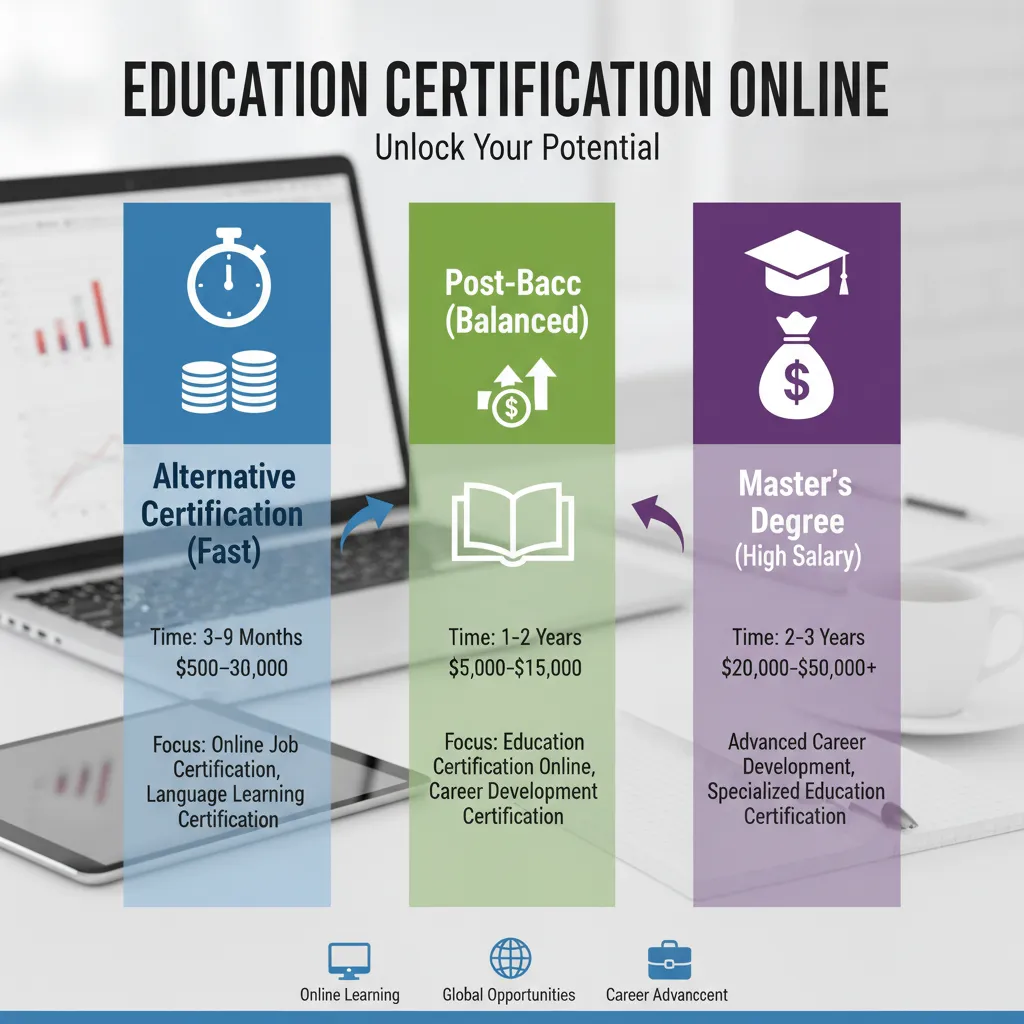
The 3 Main Pathways to Online Certification
Not all online teaching programs are built the same. Your choice depends entirely on your current education level and your budget. Let’s break down the three distinct routes.
Option 1: Alternative Certification (The “Fast Track”)
Best for: Career changers who already hold a Bachelor’s degree.
This is currently the fastest-growing sector in teacher preparation. According to Title II reports from the Department of Education, alternative certification programs now account for approximately 18-20% of new teachers entering the workforce annually.
Programs like Teachers of Tomorrow or iTeach allow you to complete coursework online at your own pace while you work. Once you pass your content exams, you are issued a “provisional” or “probationary” license, allowing you to get paid as a full-time teacher while you finish your certification requirements.
Option 2: Post-Baccalaureate Licensure
Best for: Those seeking academic depth without a full Master’s degree.
These are university-backed programs (offered by institutions like Drexel or Arizona State Online) that strip away the electives of a degree. You focus purely on pedagogy and classroom management. It’s more expensive than alternative certification but often carries more weight if you plan to move between states that are strict about university credits.
Option 3: Online Master’s (MAT/M.Ed)
Best for: Long-term salary potential and administration goals.
If you can afford the upfront cost, this is the gold standard. A 2024 Gallup/WGU Alumni Report indicated that graduates from competency-based online universities report high job satisfaction, with 76% saying they are “thriving” in their lives.
Furthermore, salary schedules in public education reward this degree immediately. According to the Bureau of Labor Statistics (BLS), while the median high school teacher salary is $64,580, teachers with a Master’s degree often start $5,000 to $10,000 higher on the district pay scale.
Step-by-Step Guide to Getting Certified Online
I’ve seen many candidates get stuck in “analysis paralysis.” Here is the actual roadmap you need to follow.
Step 1: Verify State Reciprocity & Accreditation
This is the most critical step. You must ensure your online program is approved by the Department of Education in the state where you want to teach, not just where the program is located.
However, 2025 brings good news: The Interstate Teacher Mobility Compact.
According to the Council of State Governments (CSG), as of late 2024, over 10 states—including Colorado, Florida, Kansas, Kentucky, Mississippi, Nevada, Nebraska, Oklahoma, Oregon, and Utah—have enacted legislation to streamline licensure. If you get certified online in one Compact state, moving to another is significantly easier than before.
Step 2: Choose Your Subject & Grade Level
Don’t just pick “History” because you like documentaries. You need to look at market demand. The NCES School Pulse Panel (2024) reports that 74% of public school districts found it difficult to fill positions, with Special Education and STEM (Science, Technology, Engineering, Math) being the absolute hardest to staff.
If you certify in Special Education or Math, you will likely have your pick of districts.
Step 3: Pass Content Exams (Praxis/Pearson)
You cannot escape standardized testing. Most online programs require you to pass exams like the Praxis II (Subject Assessment) before they will authorize your student teaching.
Be prepared: First-time pass rates vary. Elementary Education: Multiple Subjects exams are notoriously tricky because they test you on everything from Reading to Social Studies.
Step 4: The “Hybrid” Reality: Clinical Practice
Here is the thing most online programs bury in the fine print: You cannot become a teacher 100% online.
Every accredited program requires “Clinical Practice” (Student Teaching). This usually looks like:
- Traditional Student Teaching: 12-16 weeks of unpaid, full-time work in a classroom.
- Internship Certificate (Alt Cert): You are hired as the “teacher of record” with full pay, but you are supervised by the program for your first year.

Cost Analysis: How Much Does Online Certification Cost in 2025?
Budgeting for this requires looking beyond just tuition. I’ve broken down the real costs below based on current 2024-2025 pricing models.
| Pathway | Estimated Tuition | Time to Complete | Hidden Costs |
|---|---|---|---|
| Alternative Cert (e.g., iTeach) | $2,500 – $4,500 | 6 – 9 Months | State program fees ($300+), Exams |
| Online University Post-Bacc | $8,000 – $15,000 | 12 – 18 Months | Textbooks, Tech fees |
| Online Master’s (e.g., WGU, USC) | $12,000 – $40,000+ | 12 – 24 Months | Unpaid student teaching time |
Don’t forget the “Hidden Costs”:
- Background Checks: $50 – $100 depending on the state.
- Praxis/Pearson Exams: ~$150 per test (you may need 2 or 3).
- State Application Fees: $100 – $200.
Note: Pricing data sourced from American Board and WGU Tuition Data (2024).
Expert Perspectives on the Changing Landscape
The push for online certification isn’t just about convenience; it’s about equity and filling desperate gaps in the system.
Even major unions are recognizing the need for change, provided standards remain high. Becky Pringle, President of the National Education Association (NEA), emphasized in 2024 that strengthening public education means ensuring a system where “high expectations are matched with plentiful resources and supports.” Online programs that offer strong mentorship during the probationary period are key to meeting those expectations.
Case Study: The Career Switcher
Consider Jazmine McClure, a 2024 scholarship recipient from Teachers of Tomorrow. A career changer, she utilized the flexibility of online certification to transition into the classroom without stopping her life. She cites her own childhood teacher as inspiration: “She was such a safe space for me as a child that I knew one day I would be the same for other children.”
Stories like Jazmine’s prove that online pathways are not “shortcuts”—they are lifelines for passionate adults who cannot afford to take two years off for a traditional degree.

FAQ: Common Questions About Online Teacher Prep
Is online teacher certification legitimate?
Yes, absolutely. As long as the program is accredited by bodies like CAEP (Council for the Accreditation of Educator Preparation) and approved by your state’s Department of Education, your license is identical to one earned at a four-year university. Your diploma or certificate generally won’t even say “online.”
Can I become a teacher without a degree in education?
Yes. 48 states offer “Alternative Certification” pathways. If you hold a Bachelor’s degree in any subject (Marketing, Biology, English) and have a minimum GPA (usually 2.5 or 3.0), you are eligible to enroll.
What is the fastest online teacher certification?
Self-paced alternative programs are the fastest. Motivated candidates can finish the coursework modules in under 6 months. However, you cannot be fully certified until you complete your clinical teaching experience, which is tied to the school calendar.
Can you get a teaching certificate online in 6 months?
You can finish the coursework in 6 months, and potentially get a “Provisional” license to start working. However, a full “Standard” professional license usually requires completing one full school year of teaching.
Conclusion: Your Next Move
The teaching profession is evolving. The barriers that once kept talented professionals out of the classroom are crumbling, replaced by technology-driven pathways that respect your time and experience.
Whether you choose a Master’s from a university like WGU or a streamlined certificate from a provider like iTeach, the destination is the same: a classroom of students waiting for a leader.
My advice? Start by visiting your state’s Department of Education website today. Look for the list of “Approved Educator Preparation Programs.” If an online provider is on that list, they are legit, they are ready, and they are your ticket to a new career.