
Top Academic Certifications for New Teachers: The 2025 Career Guide
I remember standing in the hallway before my very first class, clutching a lesson plan that I had rewritten four times. The anxiety wasn’t just about managing 30 energetic students; it was the lingering question: “Am I actually qualified for this?”
If you are entering the classroom for the first time, or looking to pivot into education, you have likely realized that a bachelor’s degree is just the admission ticket. The real key to a sustainable career—and a livable wage—lies in the specific certifications you attach to your name.
In today’s educational landscape, the right certification can mean the difference between struggling to find a placement and negotiating a higher starting salary. But here is the thing: not all certificates are created equal. Some are mandatory legal requirements, while others are strategic “resume boosters” that principals love.
In this comprehensive guide, we are going to break down the “Must-Haves” versus the “Nice-to-Haves,” backed by the latest industry data. Whether you are navigating alternative certification routes or looking for that EdTech badge to stand out, this is your blueprint.

Licensure vs. Certification: Understanding the Difference
Before we dive into the specific credentials, we need to clear up a massive misconception. In my years working with new educators, the number one point of confusion is the difference between a Teaching License and a Teaching Certificate.
While the terms are often used interchangeably in casual conversation, they mean very different things to a hiring committee:
- State License (The Mandate): This is the legal permission slip granted by a state Department of Education (DOE) allowing you to teach. You cannot work in a public school without it (or a temporary version of it).
- Academic Certification (The Skill): These are credentials that prove expertise in a specific area—like “Google Certified Educator” or “National Board Certification.” These travel with you and make you more employable.
Think of it this way: The license gets you the interview; the certifications get you the job.
Must-Have State Licensure Pathways
If you don’t have your state license yet, this is your “Day 1” priority. The path you take depends largely on your background.
1. Traditional University Routes
This is the standard path: You earn a Bachelor’s in Education, complete your student teaching, and graduate ready for licensure. However, the landscape is shifting. According to a 2023 report from the Learning Policy Institute, new teachers with comprehensive preparation and certification are 2x more likely to remain in the profession. The depth of training matters for your longevity.
2. Alternative Certification Programs (The Pivot)
If you already have a degree in Biology, English, or History, you don’t need to go back for a four-year degree. Alternative Certification Programs (ACPs) are booming. In fact, Pew Research Center reported in 2023 that approximately 20% of new teachers now enter the profession through alternative certification programs rather than traditional degrees.
Case Study: The “Pivot” Teacher
Meet Sarah: A biology major who decided to teach but had no education degree.
The Action: She enrolled in a state-approved Alternative Certification Program (ACP) and took the Praxis II General Science exam.
The Result: Sarah was hired within 6 months on a “conditional license” while she finished her coursework at night. This allowed her to earn a full salary while getting certified.
3. Passing the Praxis: The Gatekeeper
Regardless of your route, you will likely face the Praxis exams. Be warned: these are not formalities. According to a 2023 report by the National Council on Teacher Quality (NCTQ), the median pass rate for the Praxis Elementary Education content exam is approximately 46% on the first attempt. This highlights the absolute necessity of dedicated preparation—do not walk into that testing center unprepared.
High-Demand Subject Area Endorsements (The “Hire Me” List)
Once you have your initial license, you can add “endorsements.” These are specialized certifications attached to your license that allow you to teach specific populations. If you want job security, look at the shortage areas.
Special Education (SPED) & Autism Certificates
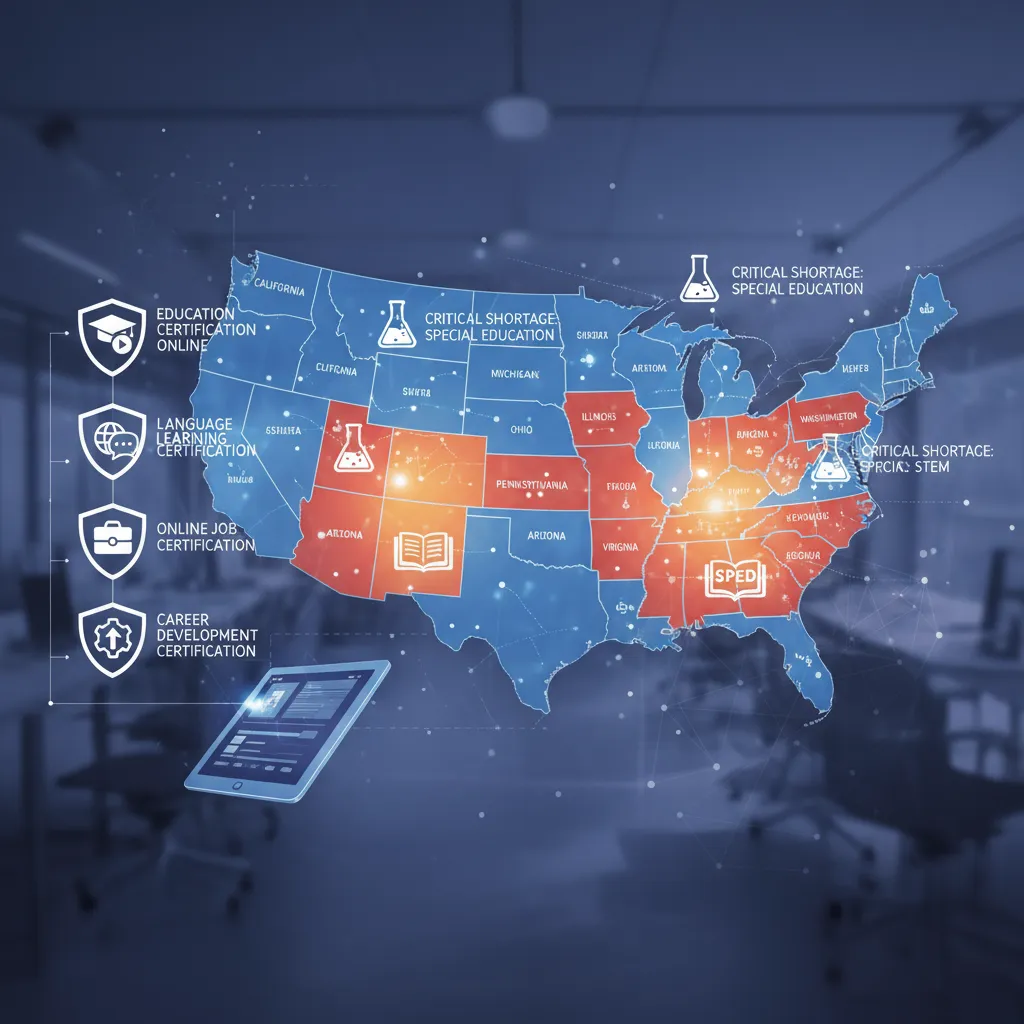
The demand here is staggering. According to the U.S. Department of Education TSAF Report (2023), 48 states reported shortages in Special Education teachers during the 2023-2024 school year.
Dr. Linda Darling-Hammond, President of the Learning Policy Institute, puts it bluntly: “The single fastest route to a contract for a new graduate is a dual certification in General Ed and Special Education. It makes you recession-proof.”
ESL / TESOL Certification
With demographic shifts, the ability to teach English Language Learners (ELLs) is a premium skill. Data from the NCES Condition of Education (2024) shows the number of English Language Learners in U.S. schools has risen to 5.3 million. Obtaining a TESOL or ESL endorsement usually requires 12-15 credit hours, but it opens doors in almost every urban district in the country.
STEM & Mathematics
If you have an aptitude for math or science, get certified in it. Frontline Education’s 2024 hiring trends indicate that over 70% of districts report difficulty hiring certified mathematics and science teachers. Even if your passion is History, having a Math certification as a backup ensures you will always have a placement.
Essential EdTech Certifications for the Modern Classroom
Post-2020, the game changed. Principals aren’t just looking for someone who can manage a classroom; they need someone who can manage a digital ecosystem. These certifications are often low-cost, high-impact resume boosters.
EdTech Reality Check
According to a 2024 Market Trends Report by FutureEd, 90% of K-12 schools currently use Google Classroom. If you don’t have a Google Educator certification, you are starting behind the curve.
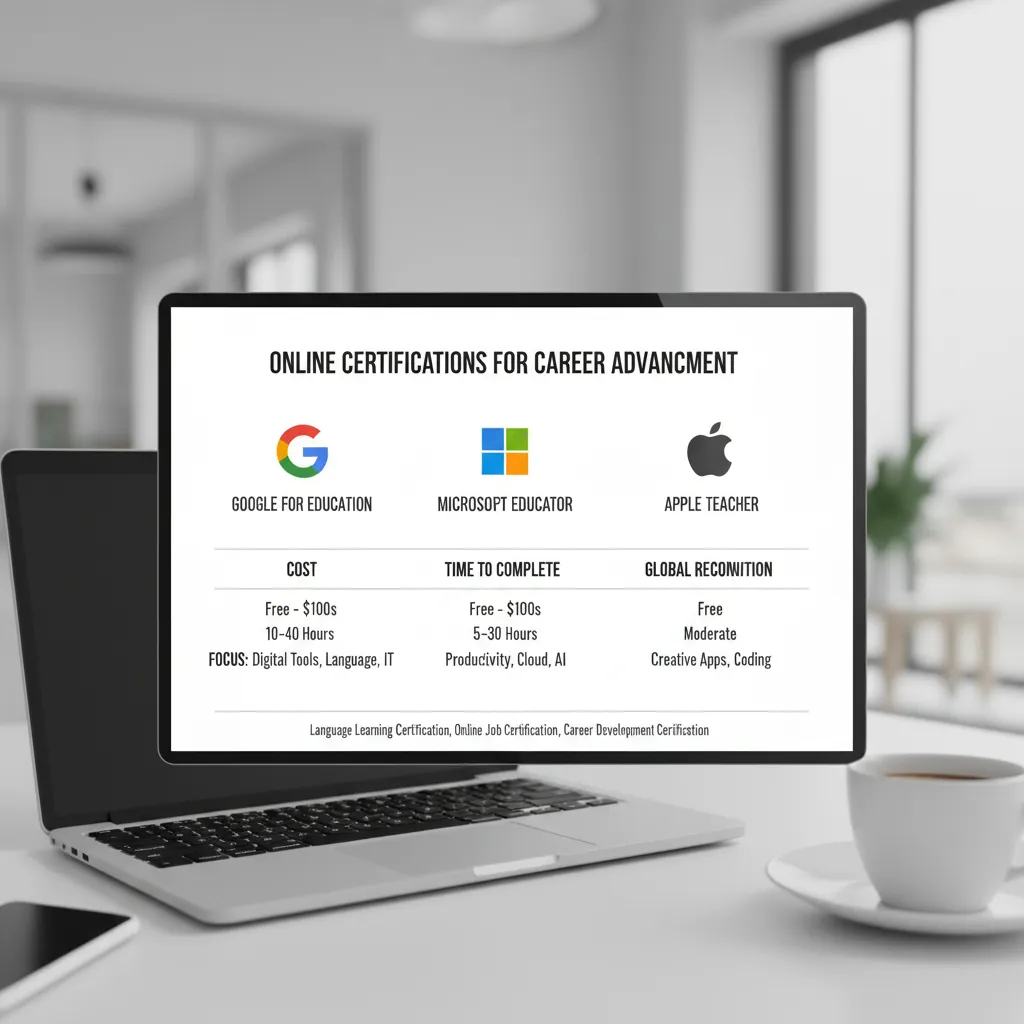
Google Certified Educator (Level 1 & 2)
For new teachers, this is the highest ROI (Return on Investment) certification available. The exam costs roughly $10-$25, takes a few hours, and gives you a recognizable badge for your resume/LinkedIn.
Microsoft Certified Educator (MCE)
While Google dominates K-12, Microsoft is huge in high schools and higher ed. As Richard Culatta, CEO of ISTE, noted in 2024, “It is no longer enough to just know your subject matter. New teachers must demonstrate digital fluency. A Google or Microsoft certification proves you can manage a modern hybrid classroom.”
Advanced Certifications for Career Growth
You might not get these in your first year, but you should be planning for them. These are the credentials that dramatically increase your salary ceiling.
National Board Certification (NBPTS)
This is the gold standard. It is rigorous and expensive, but the payoff is real. According to the NBPTS Official Impact Brief (2024), teachers who achieve National Board Certification can see salary stipends ranging from $1,000 to $10,000 annually depending on the state.
Peggy Brookins, President of NBPTS, advises: “While you can’t get National Board certified in your first year, structuring your early career professional development toward that goal sets a trajectory for master teacher status.”
Niche Certifications That Boost Employability
Sometimes, it’s the “soft skill” certifications that tip the scales in your favor during an interview.
Mental Health First Aid
In the wake of the pandemic, student mental health is a top priority. A certification in Youth Mental Health First Aid shows administrators that you are prepared for the emotional realities of the classroom. Becky Pringle, President of the NEA, stated in 2024 that “Certifications in mental health first aid and social-emotional learning are becoming as valuable as academic endorsements in the eyes of hiring principals.”
How Certifications Impact Teacher Salary in 2025
Let’s talk numbers. Why should you spend the time and money on these extra pieces of paper?
According to the National Council on Teacher Quality (NCTQ) 2023 Salary Report, teachers with a master’s degree and specialized certification earn an average of $5,000 to $10,000 more annually than those with a bachelor’s alone. Over a 30-year career, that is a difference of up to $300,000.
Furthermore, NCES data from late 2023 revealed that 45% of public schools felt they were understaffed. In a seller’s market, the teacher with the most certifications holds the negotiation power.
💰 ROI Calculator: Is the Certification Worth It?
Estimate the potential 5-year return on a specialized certification (like a Master’s or NBPTS).
Frequently Asked Questions
What certifications do I need to be a teacher?
You minimally need a bachelor’s degree and a state-issued teaching license. However, certifications in shortage areas like SPED or ESL significantly improve your chances of being hired.
Can you get a teaching certificate without a master’s?
Absolutely. Most state teaching licenses only require a bachelor’s degree. Additionally, EdTech certifications (Google, Apple) and endorsements often do not require graduate degrees.
Is National Board Certification worth it for new teachers?
It is worth planning for, but you generally need 3 years of experience before applying. It is a long-term investment that yields the highest salary bumps in the industry.
What is the easiest teaching certification to get?
Technically, a substitute teaching permit is the easiest to obtain, often requiring just a background check and a small fee. For professional certifications, the Google Certified Educator Level 1 is the most accessible and affordable.
Conclusion
Entering the teaching profession is an act of courage, but staying in it requires strategy. The landscape has shifted from a one-size-fits-all license to a portfolio of micro-credentials and specialized endorsements.
If you are just starting out, my advice is this: Secure your mandatory license, but don’t stop there. Grab the low-hanging fruit like the Google Certified Educator badge immediately—it costs less than a lunch and proves you are modern. Then, look at the data. If your state is desperate for Special Education or Math teachers, that certification is your golden ticket to job security.
Education is a career of lifelong learning. The certifications you earn today aren’t just for your resume; they are the tools you will use to change lives tomorrow.