

Earn Your Cloud Computing Certificate Online: The 2025 Career Roadmap
I still remember the first time I looked at an AWS console. It felt like staring at the cockpit of a 747—hundreds of buttons, confusing acronyms, and the lingering fear that one wrong click would cost me (or my employer) a fortune. You might be feeling that same mix of excitement and intimidation right now.
But here is the reality check: The confusion is worth navigating. The global cloud market is projected to hit $1.6 trillion by 2030 according to Grand View Research. Your slice of that massive pie starts with one piece of paper: a recognized cloud certificate.
Whether you are a complete novice trying to break into tech or an IT veteran tired of legacy systems, earning your cloud computing certificate online is the single most effective lever you can pull to increase your salary in 2025. In this guide, we are going to bypass the marketing fluff. I’ll walk you through the real ROI, the specific certifications that actually get you hired, and the study paths that work.

Why Earn a Cloud Certificate in 2025? (The Real ROI)
You might be wondering, “Is a piece of paper really going to change my career trajectory?” In my years of analyzing tech trends, I’ve seen certifications act as the primary filter for recruiters. If you don’t have the cert, your resume often doesn’t even make it past the automated screening software.
The $30,000 Difference
According to the Skillsoft IT Skills and Salary Report 2024, 97% of IT decision-makers say certified staff add value, with 22% estimating that value at $30,000 or more per year in productivity and salary potential.
Cloud vs. Traditional IT: Where the Jobs Are Moving
The days of managing on-premise servers in a freezing cold basement are fading. The modern architect must speak AWS, Azure, and Google fluently. According to the Flexera State of the Cloud Report 2024, 89% of organizations have adopted a multi-cloud strategy. This means they aren’t just using one vendor; they are using several.
This shift has created a massive skills gap. The Coursera Global Skills Report 2024 notes that 70% of businesses report a digital skills gap is a major obstacle to investment. For you, that gap represents opportunity. If you can prove you have the skills via a certificate, you are solving a painful, expensive problem for employers.
Top 3 Entry-Level Cloud Certifications for Beginners
If you have no experience, diving straight into a Professional Architect exam is a recipe for failure. You need to start with the foundational tier. These certificates validate that you understand the vocabulary, the billing models, and the basic security concepts.
1. AWS Certified Cloud Practitioner (CLF-C02)
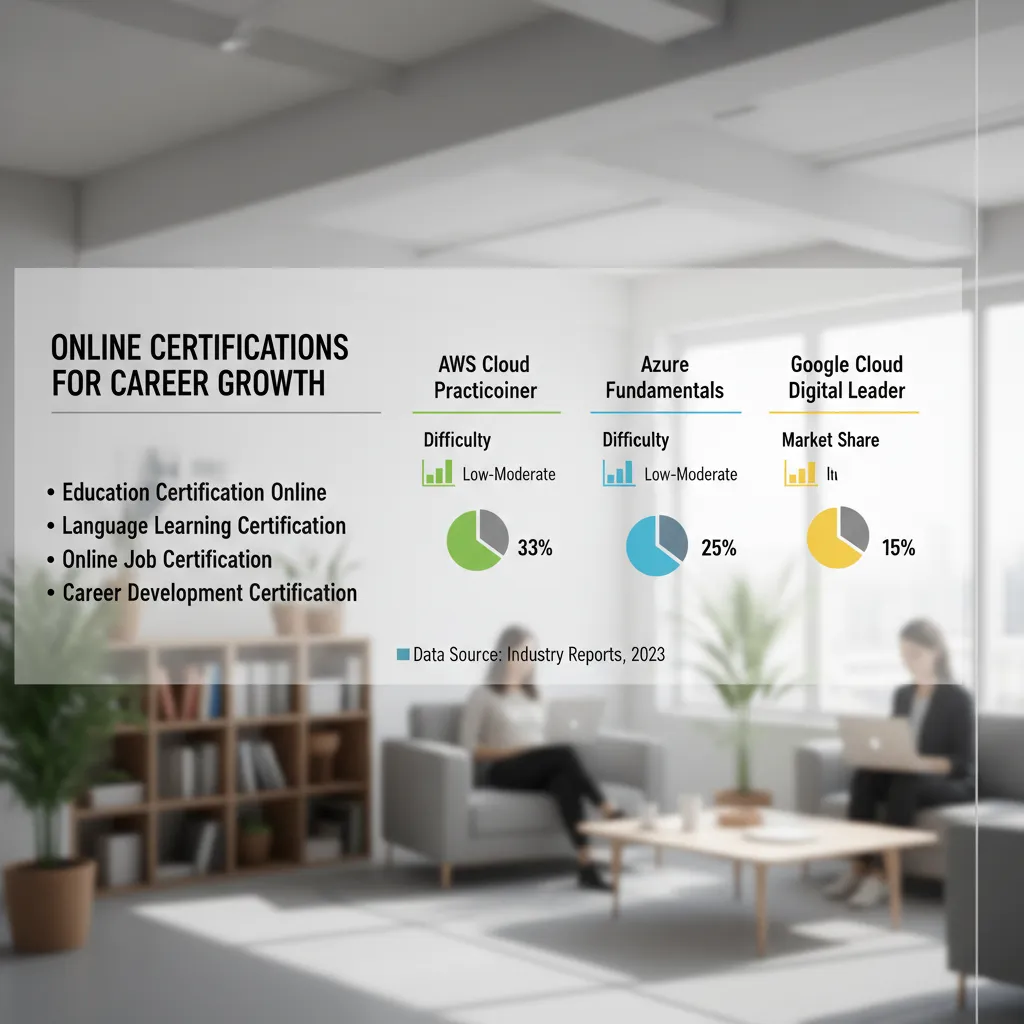
Amazon Web Services (AWS) remains the market leader. According to Statista Cloud Market Share Data Q1 2024, AWS holds roughly 31% of the market. This makes the “Cloud Practitioner” the most versatile entry-level credential you can earn.
- Best for: Generalists, sales professionals, and absolute beginners.
- Difficulty: Low. Non-technical users can pass with 2-3 weeks of study.
- Key Learning: Understanding S3, EC2, and the “Shared Responsibility Model” of security.
2. Microsoft Azure Fundamentals (AZ-900)
If you work in a corporate environment that already uses Windows, Office 365, or Active Directory, this is your path. Azure is closing the gap with AWS, holding 24% of the market.
From my perspective, the AZ-900 is slightly more intuitive for people coming from a traditional IT background because the terminology overlaps with classic Microsoft server concepts.
3. Google Associate Cloud Engineer
While Google Cloud (GCP) has a smaller market share (11%), it is dominant in data analytics, AI, and startups. This exam is technically “Associate” level, meaning it is harder than the AWS Practitioner or Azure Fundamentals. It requires some hands-on command-line experience.
Best Advanced Certificates for Career Switchers
Once you have the basics, you need to specialize. This is where the salary jumps happen. According to Skillsoft’s 2024 data, cloud certifications consistently rank in the top 5 highest-paying IT certifications, with averages exceeding $150,000 for advanced roles.
Solutions Architect Tracks
The “Architect” role is about design. It’s about looking at a client’s problem and drawing a diagram of services that solves it securely and cheaply.
- AWS Certified Solutions Architect – Associate (SAA-C03): Often called the “Gold Standard” of cloud certs. It proves you can design resilient systems.
- Microsoft Certified: Azure Administrator Associate (AZ-104): This is very hands-on. It proves you can actually click the buttons and configure the networks.
Specialized Tracks: Security & DevOps
If you want to future-proof yourself, look at security. The Certified Cloud Security Professional (CCSP) is vendor-neutral and highly respected. Additionally, with 75% of cloud decision-makers prioritizing AI/ML integration according to the Gartner Magic Quadrant 2024, specialized certifications in Machine Learning and Data Engineering are becoming gold mines.
University vs. Vendor Certificates: Which is Better?
This is a debate I see constantly on forums. Should you get a Masters in Cloud Computing or just a $150 AWS cert?
| Feature | Vendor Certification (AWS/Azure) | University Degree (Online) |
|---|---|---|
| Time to Complete | 1 – 6 Months | 1 – 2 Years |
| Cost | $100 – $300 (Exam Fee) | $10,000 – $40,000 |
| Focus | Specific Platform Skills | Theory, Management, Soft Skills |
| ROI Speed | Immediate | Long-term |
When to Choose a Full Online Degree
If you are looking to move into C-suite management or need to bypass HR filters that strictly require a master’s degree, accredited programs from universities (like WGU or Purdue Global) are valuable. They often include the vendor certifications inside the curriculum, giving you a “two-for-one” benefit.
When to Stick to Fast-Track Vendor Certs
If your goal is to switch careers fast or get a raise this year, skip the degree. Employers in 2025 prioritize “skills-based hiring.” They care more about whether you can fix a broken server pipeline than whether you wrote a thesis on cloud history.
Step-by-Step Guide: How to Earn Your Certificate Online
So, you are ready to start. Here is the exact roadmap I recommend to students to get certified in under 90 days.

Phase 1: Choosing Your Platform
Don’t just read the documentation. You need structured video courses. Platforms like Coursera and EdX offer structured learning paths. However, for specific exam prep, I often recommend dedicated platforms like A Cloud Guru or Udemy.
The key is to ensure the course was updated in late 2024. Cloud platforms change their UI monthly; studying an outdated course is a waste of time.
Phase 2: The “Hands-On Labs” Requirement
This is where most people fail. They watch the videos but never touch the console. You cannot pass a modern Associate-level exam by memorizing definitions.
You must build things. Spin up a virtual machine. Configure a load balancer. Break it, and then fix it. AWS and Azure both offer “Free Tiers” specifically for this purpose. If you walk into an interview and can’t explain a project you built, the certificate is just paper.
Phase 3: Exam Scheduling and Remote Proctoring Tips
You can take almost all these exams online from home via Pearson VUE. But be warned: the proctoring is strict. Clean your desk, remove any extra monitors, and ensure your internet is stable. I’ve heard horror stories of exams being revoked because someone walked into the room. Treat your home office like a high-security vault during the exam.
Financial Aid & Free Certification Options
Certifications can get expensive, but you shouldn’t have to pay full price.
- Microsoft Cloud Skills Challenge: Microsoft frequently runs these events (often around their Ignite conference). If you complete the learning modules, they give you a free exam voucher.
- AWS Educate: If you are a student or veteran, AWS provides free credits and training resources.
- Employer Tuition Reimbursement: According to the Skillsoft Report 2024, many organizations have unused budget for L&D (Learning and Development). Draft a proposal to your boss showing how your certification will save the company money. They will often pay for the course and the exam.
FAQ: Common Questions About Online Cloud Certificates
Is a cloud computing certificate worth it without a degree?
Yes, absolutely. In the tech industry, skills dictate hiring more than pedigree. According to Indeed Hiring Trends 2025, Cloud Engineer roles have an average base salary of $130,802, and many of these postings list certifications as a requirement while listing degrees as “preferred” or optional.
Which cloud certification is best for beginners in 2025?
For most people, the AWS Certified Cloud Practitioner is the best starting point due to AWS’s market dominance. However, if your current company uses Microsoft products, the Azure Fundamentals (AZ-900) will offer a faster return on investment for your current role.
Can I get a cloud job with just a certificate?
A certificate gets you the interview; projects get you the job. To get hired with just a certificate, you need to combine it with a portfolio. I recommend the “Cloud Resume Challenge,” where you host your resume on the cloud using the services you learned about. This proves you have practical skills.
How long does it take to get cloud certified?
For foundational exams (Cloud Practitioner), expect to study for 2-4 weeks. For Associate-level exams (Solutions Architect), plan for 3-6 months of consistent study and lab practice.
Final Thoughts: Your Next Move
The cloud computing revolution isn’t coming; it’s already here. The data from Gartner, Flexera, and Skillsoft all point to the same conclusion: the demand for certified professionals is outpacing supply.
You have the roadmap. You know the salary potential. The only thing standing between you and that career upgrade is the decision to start. My advice? Don’t overthink the “perfect” path. Pick one of the “Big Three” providers, schedule your exam for 60 days from today, and start studying. The market is waiting for you.