
How to Start a Digital Career with Certificates in 2025: The No-Degree Roadmap
Imagine this scenario: You are standing at the edge of a $18.5 trillion global economy. There is no gatekeeper asking for a diploma, and there is no bouncer checking for a university pedigree. All they ask is one simple question: “Can you do the job?”
For decades, the answer to that question required a four-year degree and tens of thousands of dollars in debt. But the landscape has shifted beneath our feet. According to a 2024 report by Lightcast & Gallup, digital skills now generate $18.5 trillion globally, representing 12% of the entire global GDP.
I’ve worked with hundreds of career switchers over the last few years, and I’ve seen a pattern emerge. The people landing high-paying roles at companies like Intact Technology, Deloitte, and even Google aren’t necessarily the ones with the Master’s degrees. They are the ones who mastered a specific skill set, proved it with a certificate, and demonstrated it with a portfolio.
If you are looking to transition from retail, hospitality, or manual labor into the digital workforce, this guide is your roadmap. We aren’t just going to talk about which courses to take. We are going to cover the missing link that most guides ignore: how to turn a piece of paper into a paycheck.
Why the “Skills-First” Economy is Your Opportunity
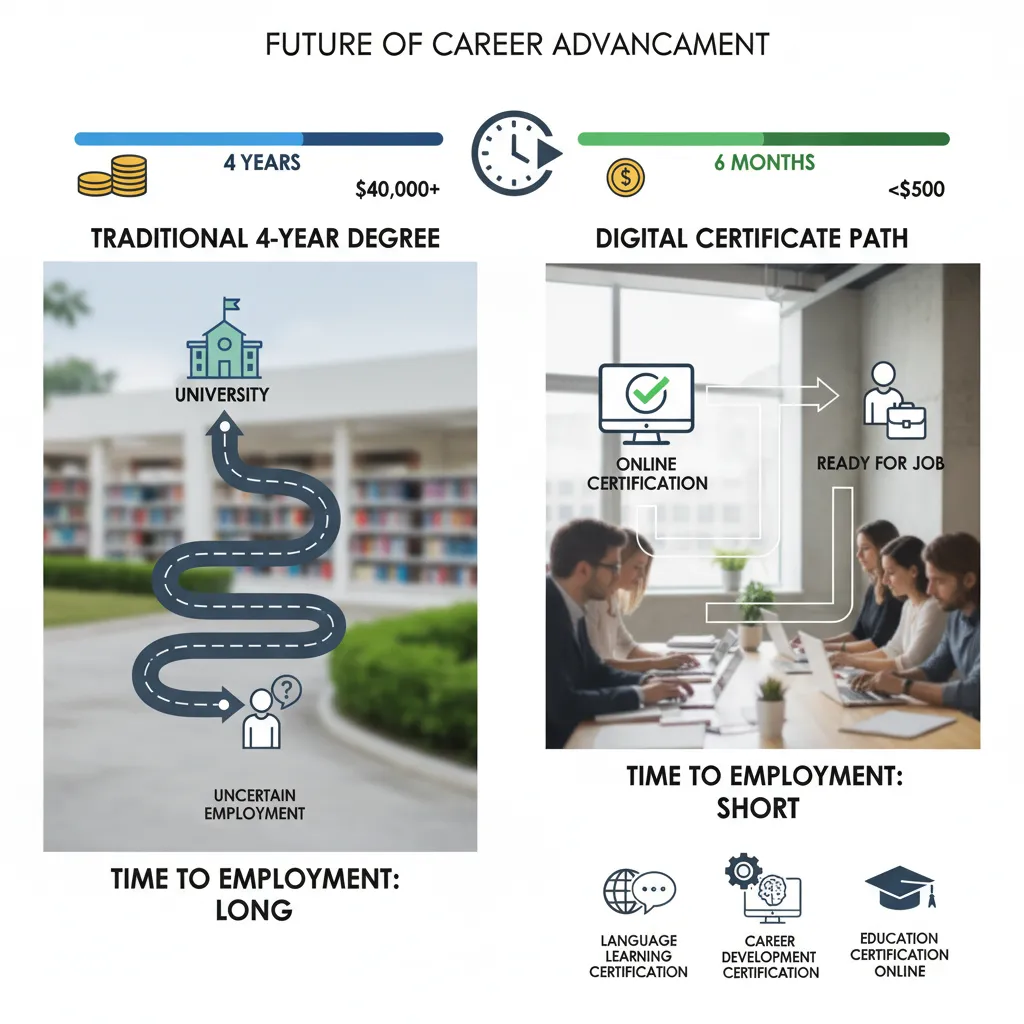
You might be wondering if this is just a temporary trend. Is it really safe to bet your career on a certificate? The data suggests that not only is it safe, but it might actually be safer than relying on outdated degree curriculums.
The World Economic Forum’s Future of Jobs Report (May 2024 Update) highlights a startling reality: 44% of workers’ skills will be disrupted in the next five years. This rapid rate of change means that what you learned in college five years ago is likely already obsolete. Employers know this.
This shift has led to “Skills-Based Hiring.” Major employers are removing degree requirements from job descriptions. According to Indeed’s Hiring Lab (Jan 2024), 50% of U.S. job postings on their platform no longer require a four-year degree. This is the open door you have been waiting for.
Top 5 High-Demand Digital Careers You Can Start with Certificates
Not all certificates are created equal. To maximize your return on investment (ROI), you need to target high-growth sectors. Based on data from Lightcast and the Upwork Freelance Forward 2024 report, here are the top five paths for 2025.
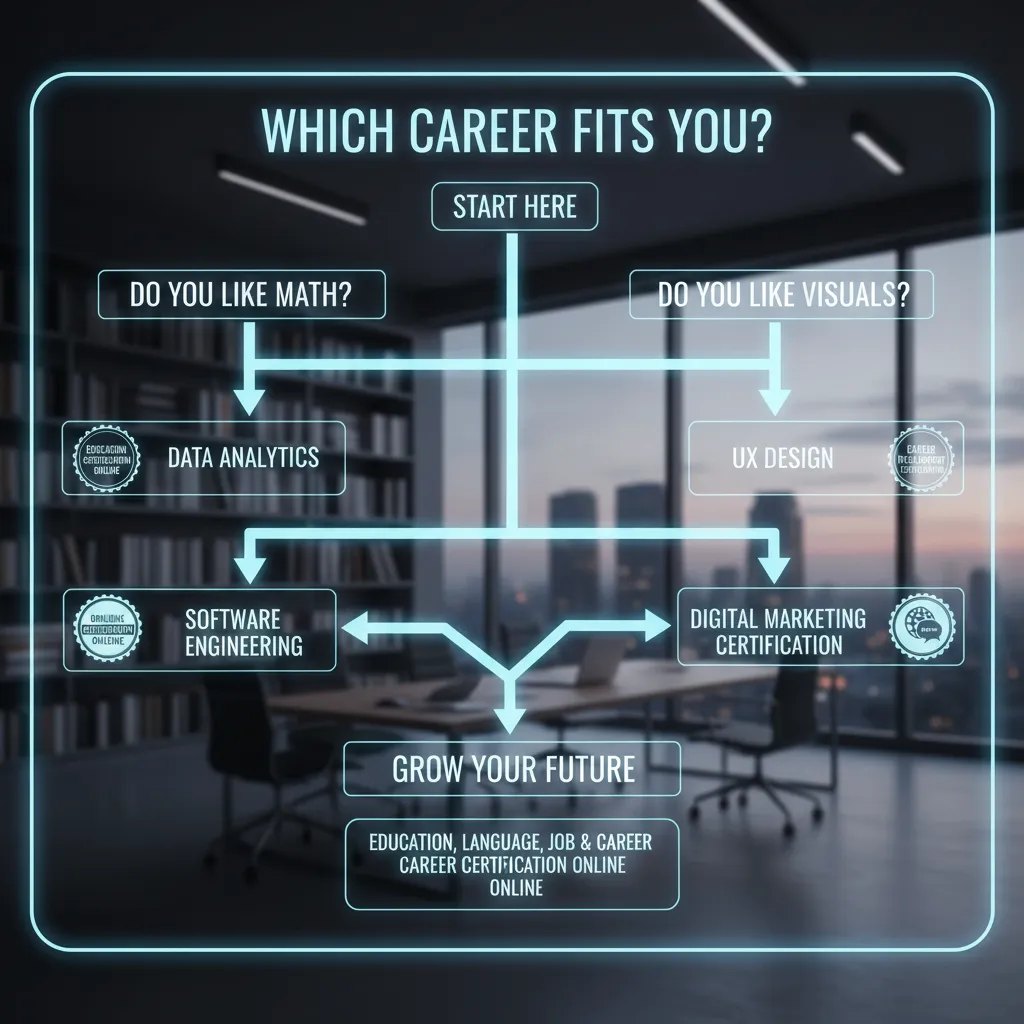
1. Data Analytics (The Logic Path)
If you enjoy spotting patterns and solving puzzles, this is your lane. Data analysts translate numbers into business decisions.
- Average Entry-Level Salary: ~$76,000+
- Top Certificates: Google Data Analytics Professional Certificate (Coursera), IBM Data Analyst.
- Why it works: Every company, from your local coffee shop to Amazon, has data they don’t know how to use.
2. Digital Marketing & E-Commerce (The Creative Path)
The demand here is explosive. Lightcast’s Digital Skills Outlook 2024 revealed that demand for Search Engine Marketing (SEM) grew by a massive 255% in just one year.
- Top Certificates: Meta Social Media Marketing, Google Digital Marketing & E-commerce.
- Why it works: It connects directly to revenue. If you can help a business make money online, you will always be employed.
3. Cybersecurity (The Protector Path)
With digital threats rising, the world is short on defenders. This role is perfect for those who are detail-oriented and protective.
- Top Certificates: Google Cybersecurity Certificate, CompTIA Security+.
- Success Story: Take Chris B., a 20-year Marine Corps veteran. After completing the Google Cybersecurity Certificate, he stated, “The very first interview that I got after finishing the certificate, I got the job.” He now works protecting infrastructure privacy.
4. User Experience (UX) Design (The Visual Path)
UX designers determine how an app feels and functions. It’s where empathy meets technology.
- Top Certificates: Google UX Design, CalArts UI/UX Specialization.
- Why it works: Bad design costs companies millions. Good design is invaluable.
5. Project Management (The Organizer Path)
If you are the person in your friend group who plans the trips and organizes the dinners, you are already a project manager.
- Top Certificates: Google Project Management, PMI CAPM.
- Why it works: Automation can write code, but it can’t yet manage complex human teams and timelines.
The “3-Stack” Strategy: How to Actually Get Hired
Here is where most people fail. They take a course, put the certificate on their LinkedIn profile, and wait for the phone to ring. It won’t.
To dominate the job market in 2025, you need to use what I call the “3-Stack Strategy.” This approach makes you undeniable to recruiters.
Advanced digital workers earn 65% more than non-digital workers.
Source: Gallup/AWS Global Digital Skills Study 2024
Layer 1: The Hard Skill (The Certificate)
This is your foundation. It proves you know the vocabulary and the tools. Whether it’s the Google Career Certificate or a Salesforce credential, this gets you past the Applicant Tracking System (ATS) bots.
Layer 2: The Soft Skill (The Differentiator)
Robots are bad at empathy, communication, and leadership. LinkedIn’s Workplace Learning Report 2024 indicates that 90% of executives are prioritizing these human skills.
Action Step: Don’t just learn Python. Take a short course on “Business Communication” or “Agile Leadership” to stack on top of your technical cert.
Layer 3: The Proof (The Portfolio)
This is the most critical layer. A certificate says you studied; a portfolio says you can build. In the next section, we will break down exactly how to build one from scratch.
Building a “Hire Me” Portfolio (Interactive Checklist)
If you have no work experience, your portfolio is your experience. You don’t need permission to build something. Here are specific project ideas for different paths:
🚀 Portfolio Project Starter Pack
- For Marketers: Do not just say you know Facebook Ads. Ask a friend with a small business (or a local charity) for $50 budget. Run a real campaign. Document the Click-Through Rate (CTR) and Cost-Per-Click (CPC). Put that case study in a PDF.
- For Data Analysts: Go to Kaggle.com, download a messy public dataset (like global temperature changes or Spotify trends). Clean the data using SQL, visualize it using Tableau or R, and publish the findings on a blog or GitHub.
- For UX Designers: Find a local restaurant with a terrible menu website. Redesign it. Show your “Before” and “After.” Explain why you made your design choices based on user accessibility.
- For Project Managers: Document a complex personal project (like a home renovation or a large event) using Asana or Trello. Show screenshots of your Gantt charts and risk management logs.
Employers want to see your process. As Google’s 2024 Impact Report notes, 70% of their certificate graduates report a positive career outcome within six months—but almost all of them leveraged the capstone projects included in the curriculum to demonstrate their skills.

Addressing the Skepticism: Do Employers Actually Care?
Let’s be real. You are likely thinking: “Will a hiring manager seriously hire me with a $39/month Coursera certificate over a computer science grad?”
The answer is nuanced. No, a certificate alone is not a magic ticket. However, a certificate combined with a portfolio acts as a bridge.
I often browse Reddit career forums, and the consensus among hiring managers is clear: “The certificate gets you past the bot; the portfolio gets you past the human.”
Real World Success: Caleel King
Background: Working as a shift leader at a fast-food chain, seeking stability.
Action: Enrolled in the Merit America program and completed the Google IT Support Certificate.
Result: Caleel transitioned into a role as a Technical Consultant at Intact Technology. He didn’t just get a job; he changed his socioeconomic trajectory. His story proves that when you combine a certificate with a support network, the barriers crumble.
Furthermore, Coursera’s Job Skills of 2024 Report shows a 1,060% increase in GenAI course enrollments. Employers are desperate for people who are up-to-date with current tech. Universities are often too slow to update their curriculum to match this speed, giving certificate holders a tactical advantage.
Financial Aid & Scholarships
If cost is a barrier, there are extensive resources available in 2025:
- Coursera Financial Aid: Almost every course on Coursera has a “Financial Aid available” link next to the enroll button. It takes 15 days to process, but it often covers the full cost.
- Merit America & Year Up: These non-profits specialize in training adults without degrees. They often cover the cost of training and provide coaching.
- Workforce Development Grants: In the US, check your local “American Job Center.” The WIOA (Workforce Innovation and Opportunity Act) often pays for certification training for underemployed individuals.
Interactive Career Salary Estimator
Curious about the potential ROI? Use this simple estimator to see what a digital career shift could look like financially.
💰 Digital Career ROI Estimator
Frequently Asked Questions (FAQ)
Which digital certificate pays the most entry-level?
Generally, Cybersecurity and Data Analytics offer the highest starting salaries, often ranging from $70,000 to $90,000 depending on location. However, they also require the most technical rigorous study compared to marketing.
Can I get a job with just a Google Certificate?
While some candidates do, it is rare to get hired solely on the certificate. As discussed in the “3-Stack Strategy,” the certificate validates your knowledge, but your portfolio and soft skills validate your employability. The certificate is the key to the door, not the job offer itself.
How long does it take to switch careers?
Most learners complete professional certificates in 3 to 6 months studying part-time (10 hours/week). Including portfolio building and job hunting, a realistic timeline for a full career pivot is 6 to 9 months.
Are free certificates worth it?
Free courses (like those on YouTube or FreeCodeCamp) are excellent for learning, but they often lack the structured assessment and recognized branding that employers look for on a resume. Paid certificates from recognized entities like Google, IBM, or Meta carry more weight in the screening process.
Conclusion: Your Timeline to Day One
The path to a digital career is no longer a secret, and it’s certainly no longer restricted to the Ivy League. The economy has shifted, and the tools are in your hands.
Here is your 90-day challenge:
- Month 1: Enroll in a certificate program and commit to 1 hour a day. No excuses.
- Month 2: Finish the course and immediately start your “Portfolio Project.” Apply the skills to a real-world problem.
- Month 3: Polish your LinkedIn profile, network with peers in your new field, and start applying.
Lisa Gevelber, the founder of Grow with Google, said it best in a 2024 podcast: “Opportunities created by technology should truly be available to everyone.”
The door is open. It’s time for you to walk through it.