
The Best Language Learning Certifications for Work in 2025: Boost Your Salary & Resume
We’ve all seen it on resumes: “Conversational Spanish” or “Intermediate French.” But as a hiring manager, I can tell you exactly what that usually means: the candidate used an app for three weeks in 2019 and can order a beer, but they certainly can’t negotiate a contract.
In the current job market, adding “Bilingual” to your resume is good. Attaching a specialized, globally recognized “C1 Business Professional” certificate is profitable. In fact, research indicates it can boost your earnings by up to 20%.
But here is the problem: the world of language testing is an alphabet soup of acronyms. DELE, DFP, HSK, TOEIC—it’s overwhelming. If you choose the wrong one, you might waste $200 and a Saturday morning on a test that employers in your industry don’t even recognize.
I’ve spent the last few weeks diving deep into labor market trends, ACTFL reports, and corporate demand statistics for 2024-2025. This article isn’t just a list; it’s a strategic guide to the best language learning certification for work that will actually get you hired and paid what you’re worth.

Why Language Certification Matters for Your Career (2024-2025 Data)
You might be wondering, “Is a piece of paper really necessary if I can just speak the language during the interview?”
The short answer is yes. The long answer involves automated resume screening (ATS) and the massive “trust gap” in recruitment. Employers are tired of vague claims. They want verification.
The “Bilingual Premium”: Real Salary Statistics
Let’s talk numbers, because that’s why you’re here. Being bilingual isn’t just a “nice-to-have” anymore; it’s a direct line to higher income. According to a 2024 analysis by Preply and Language Trainers, bilingual employees earn between 5% and 20% more per hour than their monolingual counterparts.
U.S. employers rely on employees with language skills other than English.
Source: ACTFL “Making Languages Our Business” Report
This demand is only growing. The same ACTFL report highlights that 56% of employers expect the demand for foreign language skills to increase over the next five years. If you are positioning yourself for a promotion in 2025, a validated language certification is one of the highest ROI investments you can make.
Employer Trust: Why “Conversational” Isn’t Enough
In my experience consulting with HR departments, there is a massive disconnect between what candidates think they can do and what the job requires. A report from ACTFL notes that one in four U.S. employers has lost business due to a lack of foreign language skills. They cannot afford to hire someone who “thinks” they are fluent.
“One language sets you in a corridor for life. Two languages open every door along the way.” — Frank Smith, Psycholinguist
This is where the Best language learning certification for work comes in. It removes the risk for the employer. It tells them, “A third party has tested me, and I am certified to handle your international clients.”
Best English Certifications for the Global Workplace
If English is not your native language, proving your proficiency is the single most important step for international business. However, you must avoid a critical mistake: taking an academic test for a corporate job.
Competitors often list TOEFL or IELTS as top choices. Do not make this mistake. Those are for university admissions. For work, you need business-specific credentials.
1. TOEIC (Test of English for International Communication)
The TOEIC is the absolute gold standard for the corporate world. While TOEFL tests your ability to understand a lecture on biology, TOEIC tests your ability to understand a sales meeting or a logistics email.
According to ETS (Educational Testing Service), over 14,000 organizations in 160 countries use TOEIC scores to make hiring decisions. If you are looking for a job in Asia (specifically Japan, Korea, or China) or multinational corporations in Europe, this is the test to take.
2. BEC (Cambridge Business English)
If your target job market is the UK, Europe, or Commonwealth nations, the Cambridge Business English Qualifications (B1 Business Preliminary, B2 Business Vantage, C1 Business Higher) carry immense prestige. Unlike TOEIC, which is often a multiple-choice machine, BEC tests often require deeper engagement with business case studies.
3. Linguaskill
This is the modern contender. Also from Cambridge, Linguaskill is an AI-driven, online test that provides results in 48 hours. Many tech-forward companies are adopting this for its speed and accuracy.
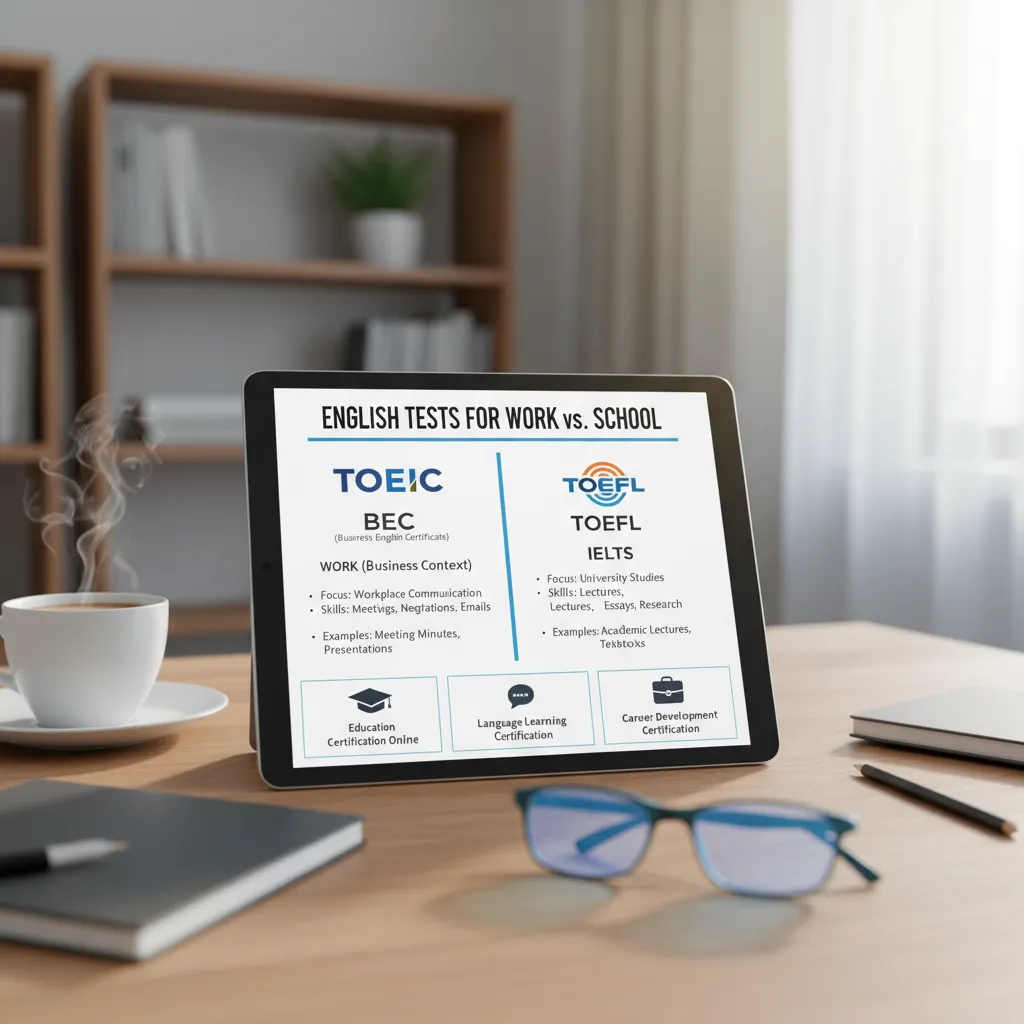
Critical Comparison: Work vs. Academic
| Feature | TOEIC (Business) | TOEFL (Academic) |
|---|---|---|
| Focus | Workplace meetings, emails, telephone conversations. | University lectures, campus life, academic essays. |
| Primary Use | Employment & Promotions | University Admissions & Student Visas |
| Cost (Approx) | $85 – $140 USD | $180 – $300 USD |
Top Certifications for High-Demand Business Languages
While English is the global lingua franca, 85% of U.S. employers report Spanish as their most in-demand foreign language, followed closely by Chinese, French, and German.
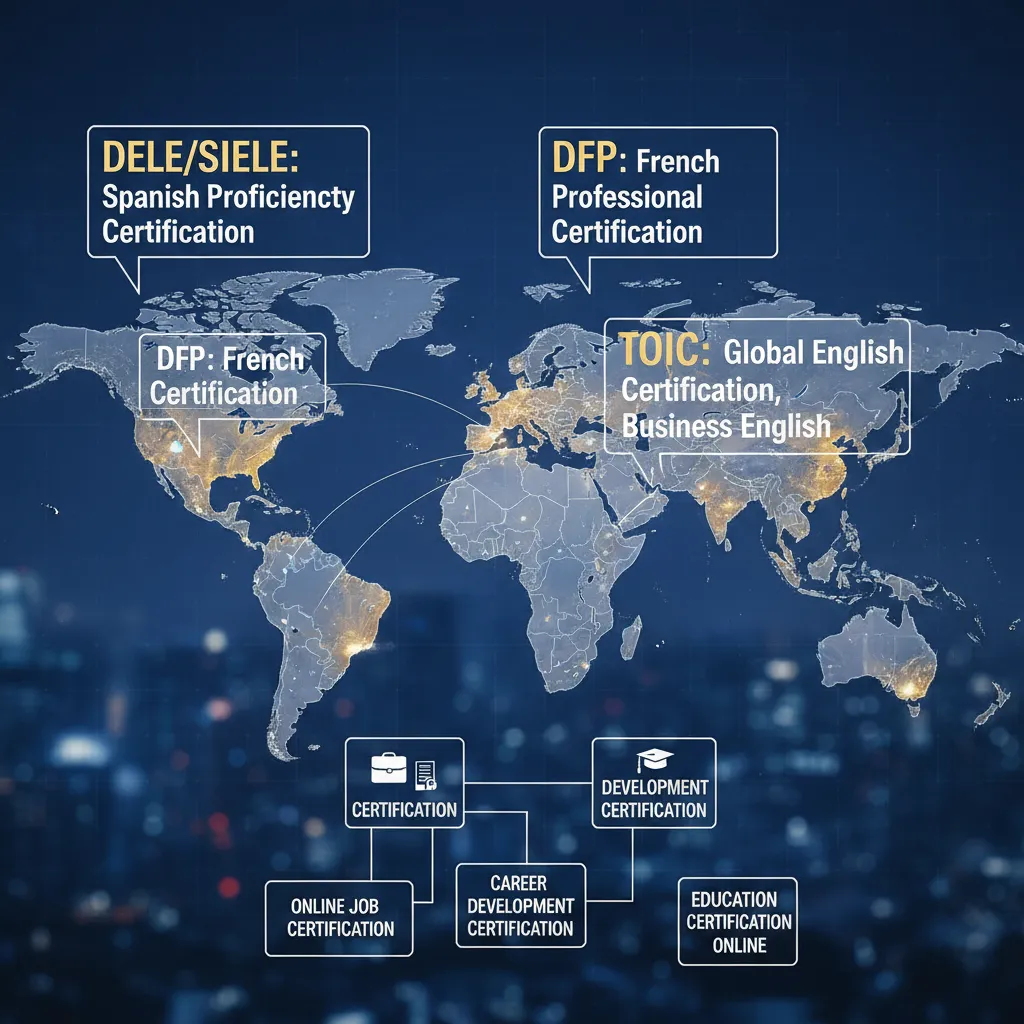
Spanish: SIELE vs. DELE
This is the most common question I get: “Which Spanish test should I take?” The answer depends entirely on your timeline.
DELE (Diplomas de Español como Lengua Extranjera) is the traditional heavyweight. It is issued by the Spanish Ministry of Education.
- Pros: The certification never expires. It is a lifetime credential.
- Cons: Results can take months. Exam dates are fixed.
SIELE (Servicio Internacional de Evaluación de la Lengua Española) is the modern, digital alternative.
- Pros: You can take it almost anytime. Results arrive in 3 weeks max. It scores you on a scale (0-1000) rather than pass/fail.
- Cons: The certificate is valid for only 5 years.
French: DFP (Diplôme de Français Professionnel)
For French, skip the general DELF/DALF if you are strictly focused on business. The DFP, created by the Paris Chamber of Commerce and Industry (CCI Paris Ile-de-France), is specifically designed for the workplace.
What makes DFP unique is that it offers industry-specific tracks. You can get certified in:
- Business French
- Medical French
- French for Tourism and Hospitality
- French for International Relations
This level of specificity is incredibly attractive to specialized employers.
Mandarin Chinese: BCT vs. HSK
Most learners know the HSK (Hanyu Shuiping Kaoshi). It is the standard test. However, the HSK is heavily focused on literature, culture, and academic vocabulary.
For work, you should look at the BCT (Business Chinese Test). This test focuses on office communication, negotiating prices, and navigating corporate life in China. While HSK is more famous, listing a high BCT score shows an employer you are ready to do business, not just read poetry.
Specialized Industry Certifications (Niche High-Value)
Sometimes, general fluency isn’t enough. In high-stakes industries like healthcare and law, you need precise terminology. A mistake here doesn’t just cost money; it can cost lives or freedom.
Healthcare: Certified Medical Interpreter (CMI)
According to Joint Commission Standards and recent hospital data, facilities that certify their bilingual staff see up to a 30% reduction in readmission rates. The CMI credential is rigorous but highly lucrative. It proves you understand medical terminology, ethics, and cultural competence.
Legal: Federal Court Interpreter Certification
This is arguably one of the hardest language tests in existence. However, the pay reflects the difficulty. Certified court interpreters can command premium daily rates that far exceed standard translation work.
How to Validate Language Skills on Your Resume
Once you have the certificate, how do you list it? “Fluent in Spanish” is out. “DELE C1 Professional” is in.
Using the CEFR Scale Correctly
Most of these exams align with the Common European Framework of Reference for Languages (CEFR). Employers, especially in Europe and multinational US firms, understand these codes:
- B2 (Upper Intermediate): The minimum for most professional jobs. You can work, but you might struggle with nuance.
- C1 (Advanced): The “Business Professional” standard. You can negotiate and handle complex tasks.
- C2 (Mastery): Near-native. Rare and often unnecessary for general business.
FAQ: Common Questions on Language Certifications
Is Duolingo accepted for employment?
Generally, no. While the Duolingo English Test is gaining traction for university admissions, most corporate employers do not view the standard Duolingo app progress as a valid certification. It is excellent for learning, but for a “best language learning certification for work,” stick to proctored exams like ACTFL or CEFR-aligned tests.
Do language certificates expire?
It depends. As mentioned earlier, exams like SIELE, TOEFL, and TOEIC typically have a 2-year or 5-year validity because language skills atrophy if not used. Exams like DELE or Cambridge (CPE/CAE) are valid for life. Always check the expiration date before listing it on a resume.
Can I take these exams online?
Since 2020, the landscape has changed. Tests like Linguaskill, SIELE, and the “Home Edition” of TOEFL/TOEIC allow for remote proctoring. This is a massive advantage for remote workers validating skills in 2025.
Conclusion: The Verdict
Investing in the best language learning certification for work is about more than just pride; it’s a calculated career move. The data from ACTFL, Preply, and Pearson all point to the same conclusion: the global economy is multilingual, and those who can prove their skills earn the premium.
Your Action Plan:
- Assess your goal: If you want a job in Japan, take the TOEIC. If you want a job in Spain, take the SIELE (for speed) or DELE (for life).
- Check your level: Don’t pay for a C1 exam if you are currently B1. Take a free online placement test first.
- Book the exam: Having a date on the calendar is the best motivation to study.
Don’t let your skills remain a “hidden asset.” Certify them, put them on your resume, and negotiate the salary you deserve.