
Language Credentials That Employers Actually Want (2025 Data & Salary Guide)
Let’s be brutally honest for a moment: relying on a 300-day “streak” from a language app to secure a job is a career mistake. In my years analyzing recruitment trends, I’ve seen countless resumes rejected because the candidate listed “fluent” based on gamified learning, only to crumble during the first minute of a bilingual interview.
In 2025, the stakes are higher than ever. Employers aren’t just looking for casual conversation skills; they are looking for risk reduction. They need proof.
The financial incentive for getting this right is massive. According to a December 2024 report by Afni Careers, bilingual employees earn on average 5% to 20% more than their monolingual counterparts. Yet, there is a disconnect between how we learn languages and how we prove we know them.
If you want to move from “hobbyist” to “hired,” you need the specific language credentials that hold weight in the global market. This guide strips away the marketing fluff and focuses solely on the standardized tests and certifications that actually dominate Google rankings for employability and salary negotiations.
The “Credential Gap”: Why App Badges Don’t Work
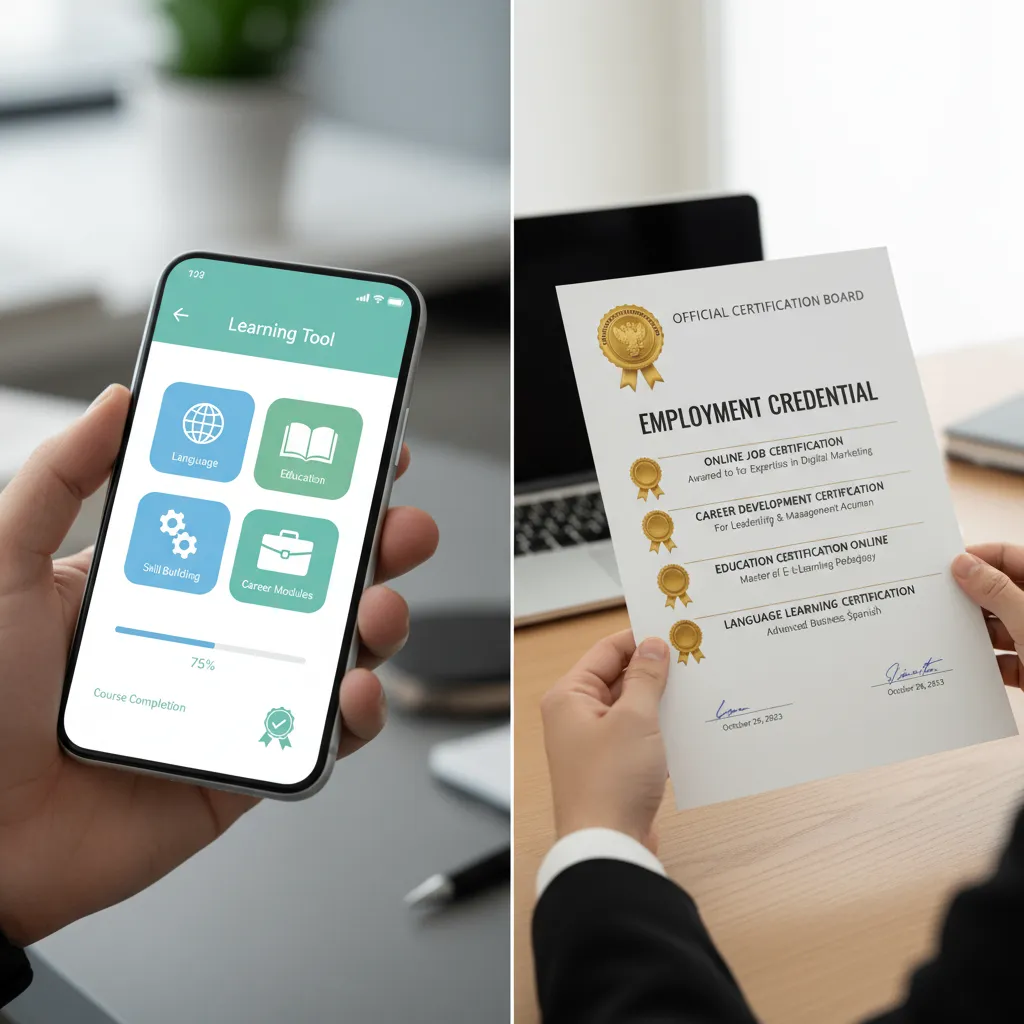
We live in a golden age of language learning, but a dark age of verification. While apps like Duolingo or Babbel are fantastic for acquisition—getting the language into your brain—they are rarely accepted as proof of proficiency by HR departments.
Why? Because corporate language assessment requires standardized, proctored validation. A streak proves dedication, but it doesn’t prove you can negotiate a contract or manage a patient’s medical intake.
The industry data supports this shift toward formalization. According to ACTFL’s “Making Languages Our Business” report, 9 out of 10 U.S. employers rely on employees with language skills other than English, but they increasingly struggle to verify these skills accurately without standardized testing.
Becky Gundy, Head of B2B Marketing at Babbel, noted in WorkLife that “In a competitive job market, bilingualism can set you apart… Companies often seek employees who can help them navigate different cultures and markets.” But to set yourself apart, that bilingualism must be quantified.
The Gold Standards: Frameworks That Get You Hired
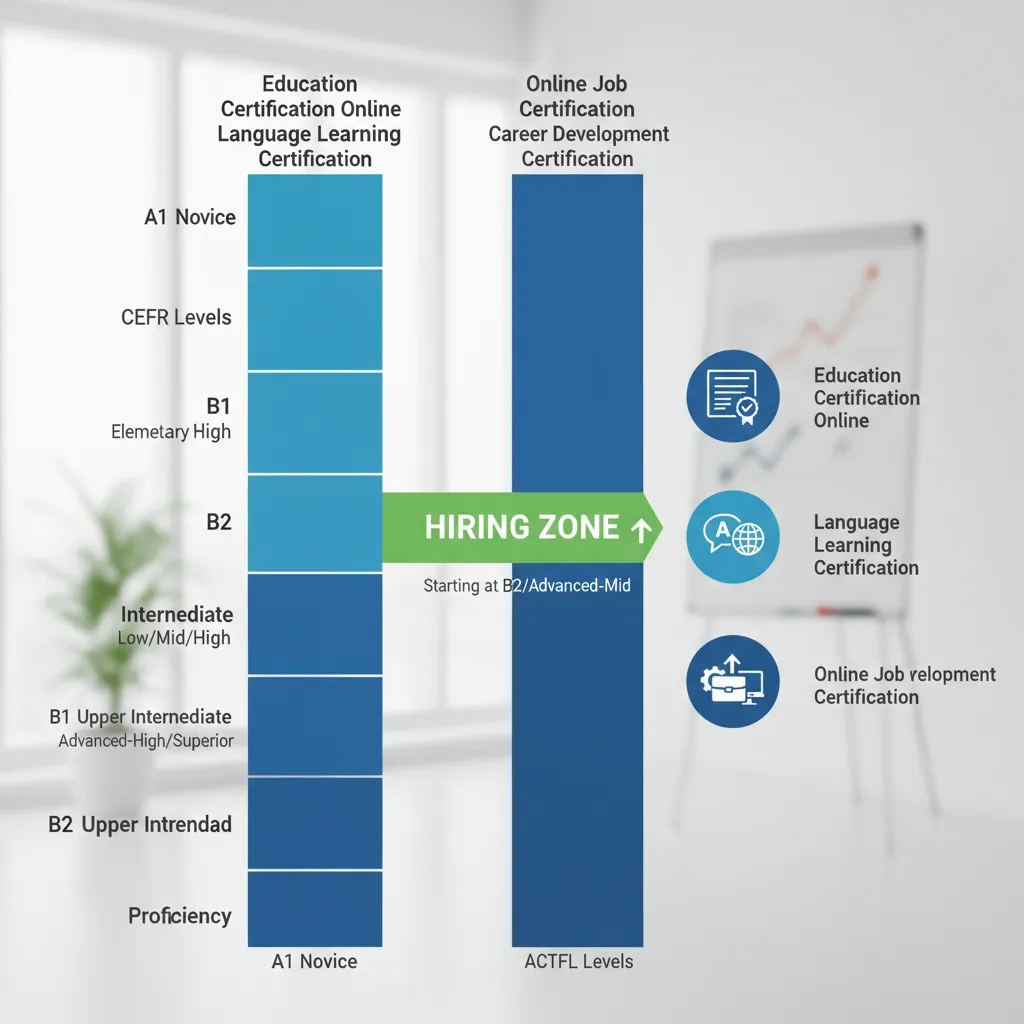
Before you pay for a test, you must understand the two languages of recruitment: CEFR and ACTFL. If you are applying for a job and simply write “Intermediate Spanish,” you are forcing the recruiter to guess. If you write “Spanish: CEFR B2 (Professional Working Proficiency),” you are speaking their language.
1. The CEFR (Common European Framework of Reference)
While European in origin, this is the global standard for multinational corporations. It breaks down proficiency into six levels:
- A1/A2 (Basic): Good for tourism, useless for business.
- B1/B2 (Independent): The employment “sweet spot.” B2 is generally considered the minimum for professional working proficiency.
- C1/C2 (Proficient): Near-native fluency. Required for legal, academic, or high-level diplomatic roles.
2. The ACTFL (American Council on the Teaching of Foreign Languages)
If you are applying for jobs in the US—especially government or healthcare roles—this is your benchmark. The ACTFL scale moves from Novice to Distinguished.
The most valuable specific credential here is the OPI (Oral Proficiency Interview). It’s a rigorous telephone interview that rates your speaking ability. Many US federal contractors specifically look for “ACTFL Advanced-Mid” or higher.
Top Language Certifications by Language (2025 Demand)
Not all tests are created equal. Some expire; some are permanent. Some are academic; others are for business. Based on search intent signals and hiring requirements, here are the specific tests you should target.
English (For Non-Native Speakers)
English remains the most learned language globally, accounting for 43% of learners according to Preply’s December 2024 Global Trends. However, the certification you choose dictates where you can work.
- IELTS (General Training): The gold standard for migration to the UK, Canada, and Australia.
- TOEFL iBT: Heavily preferred by American universities and academic institutions.
- TOEIC: The corporate standard in Japan and Korea. If you want to work for a giant like Sony or Samsung, this is non-negotiable.
Spanish (High Demand in Healthcare & Construction)
With 85% of US employers reporting a reliance on Spanish speakers (ACTFL Data), verifying this skill is crucial.
- DELE (Diplomas de Español como Lengua Extranjera): Issued by the Spanish Ministry of Education. It is permanent and widely respected in Europe.
- SIELE: A newer, digital exam covering Spanish for Spain and Latin America. It offers a score rather than a pass/fail, which can be less stressful.
Sector Spotlight: In the US healthcare sector, the demand is explosive. A February 2024 analysis by ICLS indicates that healthcare employers expect a 64% increase in demand for foreign language skills over the next five years.
Mandarin Chinese (International Trade)
Despite geopolitical shifts, Mandarin remains essential for supply chain and global trade roles. 34% of US employers cite a dependency on Chinese speakers (ACTFL).
- HSK (Hanyu Shuiping Kaoshi): This is practically the only certification recognized by Chinese companies and the government. It has recently been updated to a 9-level scale (formerly 6), making the higher levels much harder to achieve.
French (Diplomacy & Africa)
- DELF (A1-B2) / DALF (C1-C2): Administered by the French Ministry of Education. These diplomas are valid for life. B2 is typically the minimum for professional roles in France or Quebec.
Japanese (Niche High Pay)
According to data from Preply and EIN Presswire (March 2024), Japanese tops the list for best-paid non-native languages in markets like Singapore.
- JLPT (Japanese-Language Proficiency Test): There are five levels (N5 to N1). For employment, N2 is the standard minimum. N1 is often required for translation work.

The ROI of Language Skills: 2024-2025 Salary Data
Is the stress of an exam worth it? The data says yes. We aren’t just talking about “employability”—we are talking about hard currency.
The Bilingual Pay Gap
We previously mentioned the 5-20% boost found by Afni Careers. However, for specialized degrees, the gap widens. Language Trainers reported in July 2024 that bilingual MBA graduates in the US earn 22% more in starting salaries compared to their monolingual peers.
Specific Language Premiums
Different languages command different market rates based on scarcity and economic power:
- German (USA): German is consistently a top-paying language, with average salaries listed around $50,873, but often scaling much higher in engineering and tech roles (Preply Data 2024).
- Arabic (UK): In the UK market, Arabic is the highest-paying second language, commanding an average salary of £52,806 (Preply Report).
Business Efficiency Boost
It’s not just about your salary; it’s about your value to the company. Businesses report a 22% increase in efficiency when working with bilingual employees, according to Gitnux market data cited by WorkLife.
Emerging Trends: Remote Work & “Skill Verification”
As we move through 2025, the landscape of work is shifting. The rise of remote work has created a “geo-arbitrage” opportunity for multilingual workers.
According to the Bureau of Labor Statistics (BLS) and cited in an October 2024 report by Anzu Global, the employment of interpreters and translators is projected to grow by 20% through 2031—much faster than the average for all occupations. This growth is largely driven by software localization and the need to serve global customers remotely.
The Global Seal of Biliteracy
A newer trend gaining traction is the Global Seal of Biliteracy. This is a universal credential that validates language skills regardless of how they were acquired (school, home, or software). It is increasingly recognized by HR departments because it ties directly to the ACTFL and CEFR scales, offering a “serial number” for your fluency that employers can verify.
FAQ: Common Questions on Language Credentials
Does Duolingo count as a certification on a resume?
Generally, no. While Duolingo now offers the “Duolingo English Test” (DET) which is accepted by many universities, the standard “tree” completion or XP streak is not a professional credential. It is a learning milestone. For employment, stick to ACTFL or CEFR validated exams.
How should I list language levels on my resume?
Avoid one-word descriptors like “Fluent.” Instead, use a format that provides context and proof. For example:
“Spanish: Professional Working Proficiency (ACTFL Advanced-Mid / DELE B2 Certified)”
Do language certificates expire?
It depends on the test. Proficiency exams for academic entry (TOEFL, IELTS) usually expire after two years because language skills atrophy without use. Diplomas like the DELF (French) or DELE (Spanish) are technically valid for life, though employers may ask for a recent assessment if the certificate is over 10 years old.
Is B2 level good enough for a job?
Yes. B2 (CEFR) is widely regarded as the “Professional Working Proficiency” threshold. It means you can understand complex text, handle technical discussions in your field, and interact with native speakers without strain. C1/C2 is excellent but usually not required unless you are a lawyer or writer.
Conclusion: Don’t Just Learn, Certify
In a world where only 20% of the US population can fluently speak a second language (Afni Careers Analysis), possessing verified language skills makes you a unicorn in the job market.
The data from 2024 and 2025 is clear: the salary premium exists, the employer demand is growing (especially in healthcare and tech), and the reliance on formal credentials is tightening. Employers are done guessing. They want proof.
My advice? Look at the industry you want to enter. If it’s Asian commerce, book your HSK or TOEIC. If it’s European luxury goods, secure your DELF or DELE. Treat your language skills not as a soft skill, but as a technical certification—because that is exactly how your future employer views them.
Take the Next Step
Review your resume today. If your language skills are listed as “Conversational,” find the nearest testing center for the exams listed above and schedule an assessment for Q1 2025. It might be the highest ROI investment you make this year.