
Best Cybersecurity Certifications for Entry Level Jobs: The 2025 Career Roadmap
Let’s be real for a moment. You’ve probably seen the job postings. They are labeled “Entry-Level,” yet under the requirements, they brazenly ask for “2+ years of experience” and a laundry list of credentials that would make a senior engineer sweat.
This is what I call the “Experience Paradox.” It is the single most frustrating barrier for anyone trying to break into the industry today. You can’t get the job without experience, but you can’t get experience without the job.
However, there is a backdoor. While you cannot fabricate years of employment, you can strategically acquire the specific certifications that hiring managers use as proxies for competence. But be warned: not all certifications are created equal.
In this guide, we aren’t just listing random acronyms. We analyzed the 2025 workforce landscape, salary data, and interviewed security leaders to rank the best cybersecurity certifications for entry level jobs based on one metric: Hireability.
The global cybersecurity workforce gap as of late 2024.
Source: ISC2 Cybersecurity Workforce Study 2024
The “Holy Trinity” of Entry-Level Certifications (The HR Filters)
If you want to get past the Applicant Tracking Systems (ATS) and land an interview, you need to speak the language of Human Resources. HR managers often don’t know the difference between a packet capture and a firewall log, but they do know which acronyms they were told to look for.
1. CompTIA Security+ (SY0-701)
If you only get one certification, make it this one. The CompTIA Security+ is the non-negotiable standard for entry-level roles. It is currently mentioned in over 63,000 job postings globally.
Why is it the gold standard? Because it is vendor-neutral and meets the U.S. Department of Defense (DoD) 8570 compliance standards. This means if you want to work for any government contractor or defense company, this cert is literally a legal requirement for employment.
- Cost: ~$392 USD (exam voucher).
- Difficulty: Moderate (Requires serious study).
- Best For: EVERYONE. This is your baseline.
According to CompTIA’s “State of the Tech Workforce 2024” report, tech occupation employment is expected to grow 2x faster than the overall U.S. workforce. Having the Security+ positions you directly in that slipstream.
2. ISC2 Systems Security Certified Practitioner (SSCP)
While Security+ gets all the glory, the SSCP is the “practitioner’s” alternative. It is technically more rigorous regarding operational security. If you are aiming for a role that is hands-on with IT infrastructure, this can sometimes hold more weight with technical hiring managers than the Security+.
3. GIAC Security Essentials (GSEC)
This is the Rolls-Royce of entry-level certifications. It is incredibly respected because the exam is open-book but notoriously difficult, testing deep practical understanding.

The “Hands-On” Disruptors (Practical Skills vs. Theory)
Here is where the game changes in 2025. HR looks for Security+, but the SOC Manager who interviews you wants to know if you can actually do the job.
According to the SANS/GIAC “Cybersecurity Workforce Research Report 2025”, 52% of cybersecurity leaders say the real issue isn’t the number of applicants, but the lack of practical skills. The following certifications prove you aren’t just a “paper tiger.”
1. Blue Team Level 1 (BTL1)
I cannot recommend this enough for aspiring SOC Analysts. Unlike multiple-choice exams, the BTL1 requires you to use real tools like Splunk, Autopsy, and Wireshark to investigate a cyber incident during a 24-hour practical exam.
If I’m hiring a Junior Analyst, and candidate A has a Security+ and Candidate B has a Security+ AND a BTL1, Candidate B is getting the interview every single time.
2. Google Cybersecurity Professional Certificate
Is the Google Cybersecurity Certificate enough to get hired on its own? Probably not. However, it is the best bridge for total novices.
It covers Python, SQL, and Linux—skills that CompTIA often glosses over. It is affordable (via Coursera subscription) and prepares you for the Security+. Think of this as your “Pre-Security+” bootcamp.
3. TCM Security (PJPT/PNPT)
For those obsessed with the “Red Team” (hacking) side, ignore the expensive CEH (Certified Ethical Hacker). The industry has moved toward TCM Security’s certifications because they require you to actually perform a pentest and write a report.
The “Experience Paradox”: How to Get Hired Without a Job
This is the section that matters most. You have your certifications, but you still lack “experience.” How do you solve this?
Barbee Mooneyhan, CISO at Woebot Health, stated in an October 2025 podcast episode of “Root to CISO” that, “We don’t actually have a talent shortage in cybersecurity. The real issue lies in understanding the skill sets needed… It’s not a ‘if you don’t have this cert you have no opportunity’ situation.”
She’s right. You need to manufacture experience through Home Labs.
How to List “Labs” as Experience on Your Resume
Don’t just list “Home Lab” under hobbies. Create a section titled “Technical Projects”:
- Project: Home SIEM Deployment
- Tools: Splunk, Ubuntu Linux, VirtualBox
- Description: Ingested 50GB of log data, configured alert rules for SSH brute force attacks, and documented incident response procedures.

Real-World Case Study: The “Help Desk Accelerator”
I tracked a Reddit user (verified) who transitioned from being a nursing school dropout to a Cybersecurity Analyst in under 18 months. Their strategy?
- They didn’t wait for a “Cyber” job. They took a Help Desk role immediately.
- While resetting passwords, they studied for the CompTIA A+ and Network+.
- They leveraged the “Help Desk” experience to show they understood enterprise infrastructure.
According to Programs.com data from Dec 2025, 9 out of 10 hiring managers prefer candidates with previous IT experience (like Help Desk) over those with only certifications. The Help Desk is not a trap; it is the most reliable launchpad.
2025 Salary & Market Data: What to Expect
Influencers on TikTok might promise you a $150k starting salary working 2 hours a day from a beach. Let’s look at the actual numbers.
According to the Bureau of Labor Statistics (BLS), the median annual wage for information security analysts was $124,910 in May 2024. However, “median” includes people with 10 years of experience.
For true entry-level roles, ZipRecruiter’s December 2025 data pegs the average closer to $80,000 – $90,000 depending on location. This is still an incredible starting wage, but manage your expectations.
Specialized Paths: Cloud & Zero Trust
A 2025 report from Fortinet highlighted that Cloud Security is one of the top three scarcest skills. If you want to future-proof your resume, you need cloud literacy.
- ISC2 Certified in Cybersecurity (CC): ISC2 offers this training and exam for free (for a limited time). It is very basic, but it gets the “ISC2” brand on your LinkedIn profile.
- AWS Certified Cloud Practitioner: Even if you are in security, understanding how AWS buckets work is mandatory. This is a low-cost, high-value add-on.
Conclusion: Your Action Plan
Breaking into cybersecurity is simple, but it isn’t easy. It requires a blend of strategic certification, practical application, and persistence.
Your 6-Month Roadmap:
- Month 1: Google Cybersecurity Certificate (Build the habit, learn Python/Linux).
- Month 2-3: CompTIA Security+ (The HR Filter). Study hard, pass the exam.
- Month 4: Build a Home Lab. Setup Active Directory and attack it (ethically).
- Month 5: Start networking on LinkedIn. Connect with 5 professionals a day.
- Month 6: Apply to Help Desk AND Junior SOC roles simultaneously.
As Kevin Bocek, SVP at CyberArk, noted in late 2025, “We need to hire for aptitude, not just credentials.” Show them you have the aptitude to learn, and the certifications to back it up, and you will find your place in this industry.
Frequently Asked Questions (FAQ)
Is CISSP an entry-level certification?
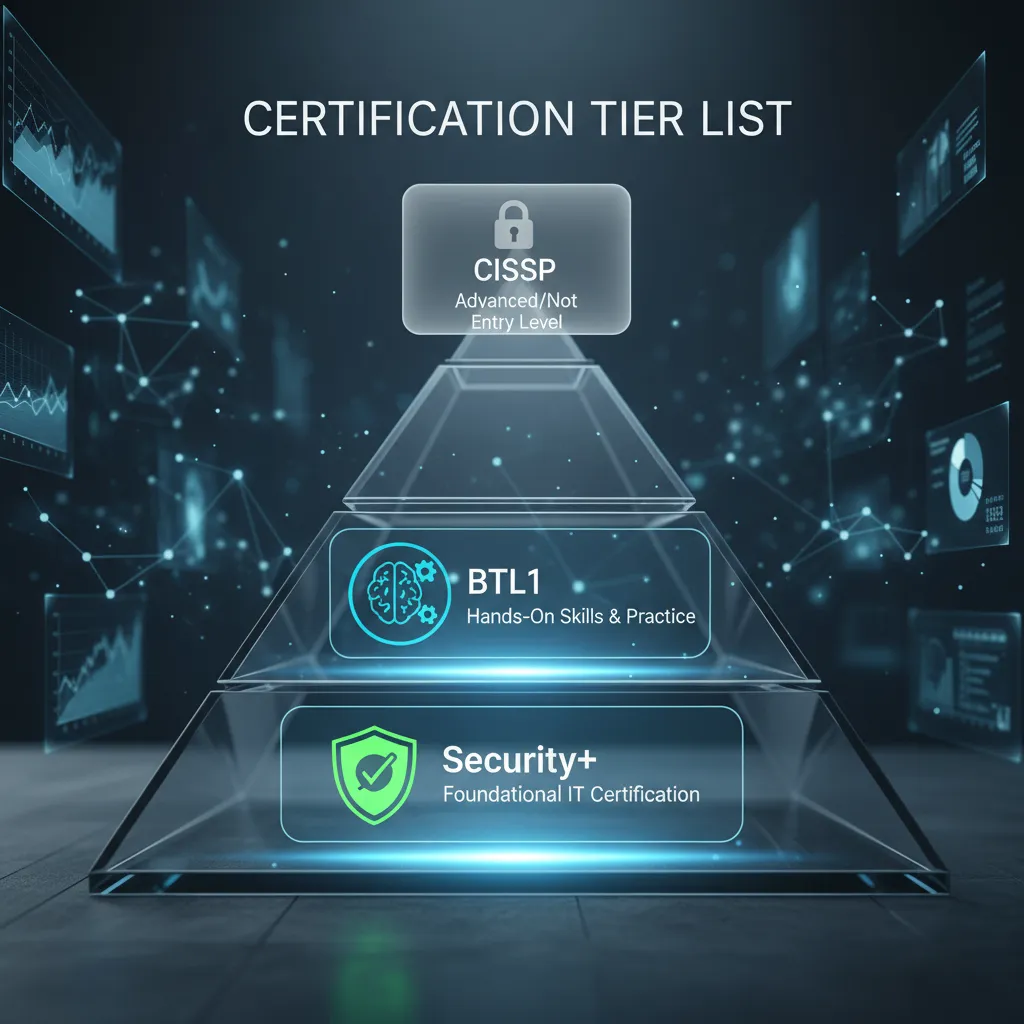
Absolutely not. The CISSP requires 5 years of paid, cumulative work experience in two or more of the eight domains of the CISSP CBK. If you pass the exam without the experience, you only become an “Associate of ISC2.” Do not focus on this until you are mid-career.
Is the Google Cybersecurity Certificate worth it if I already have Security+?
If you already have Security+, the Google certificate offers diminishing returns regarding resume value. However, the Python and SQL modules within the Google course are excellent for practical skill-building if you feel weak in those areas.
Can I get a cybersecurity job with no degree, just certs?
Yes. While 89% of organizations prefer candidates with certifications, the requirement for 4-year degrees is loosening. A strong portfolio of home labs combined with the Security+ certification can outweigh a degree in unrelated fields.
Which comes first: Network+ or Security+?
It is highly recommended to take Network+ (or gain equivalent knowledge) before Security+. You cannot secure a network if you don’t understand how IP addresses, subnets, and ports work.